business
From Kitchen to Clients: How to Start a Catering Business


Intro
Every wedding, office party and family gathering needs food, and someone has to cook it, deliver it and serve it beautifully. That someone could be you. Catering is one of the friendliest food businesses to start because you do not need a restaurant, a dining room or a long lease — just good cooking, reliable organisation and clients who trust you with their big day. The question most beginners ask first is how to start a catering business, and the honest answer is that it rewards people who plan carefully, start small and treat every event as an audition for the next one.
The money side is just as important as the menu. What it costs to start a catering business depends on your model: a home-based drop-off caterer can launch for a few thousand dollars, while a full-service operation with a commercial kitchen, staff and its own transport runs into the tens of thousands. This guide walks through every step of the journey, from picking a niche to booking your first paying clients, with real numbers at each stage, so you can build a business that survives its first year.
Step 1 — Pick a niche you can actually cook for
Catering is a broad word, and the caterers who do well are the ones who pick one corner of it and own it. Weddings, corporate lunches, private parties, cultural celebrations, drop-off office meals, dessert tables, barbecue events — each niche has different clients, different budgets and different expectations. A short list of catering business ideas is the best place to start: write down five niches, then score each one on what you cook best, who pays for it in your area and how often those events happen.
Test your niche before you spend serious money. Cook the menu at home, cater a friend’s party at cost, and watch what people actually eat and what comes back untouched. The dishes that disappear are your niche; the ones that linger are a warning. Think about volume too. Food that serves beautifully for ten people can fall apart for two hundred, so test your best dishes at scale before you promise them to a paying client. Your strongest catering business ideas are the ones you can cook consistently, transport safely and serve hot — or cold, exactly as intended — at someone else’s venue.
Step 2 — Give the business a name and a legal shape
A good name does real work: it tells clients what you do, it fits on a menu and a van, and people can remember it after hearing it once. When you are brainstorming catering business names, say each one out loud, check it is not already used by another caterer in your area, and make sure the web address and social media handles are free. Short names win. Avoid clever spellings that people cannot type after hearing them once, and avoid names that lock you into one dish if you plan to grow beyond it.
The best catering business names also survive a quick trademark and web search, so check before you print anything. Once the name is settled, choose a legal structure. Most small caterers start as a sole proprietorship or a limited liability company, and the right choice depends on your local rules, your personal liability and your tax situation. Register the business name with your local authorities, get a tax number, and open a separate business bank account on day one. Mixing business money with household money is the fastest way to lose track of whether you are actually making a profit.
Step 3 — Write a catering business plan
You do not need a fifty-page document, but you do need a written plan that forces you to face the numbers. A solid catering business plan covers your niche, your target client, your menu and prices, your kitchen, your startup budget, your monthly running costs and the sales you need to break even. Writing it down is what turns a daydream into a business you can actually run.
Start with the break-even maths. If your average event brings in $2,000 and your food and labour costs run to 60% of that, you keep about $800 per event before other costs. If your fixed monthly costs — kitchen rent, insurance, transport and your own wage — come to $2,400, you need three events a month just to stand still. That single calculation tells you whether your chosen niche can support you, and it is the number your bank or lender will ask for first. A good written plan also lists your first ten target clients by name — venues, offices, planners — because a plan without named clients is just a wish list. Revisit the plan every month once you are trading, because the plan that survives is the one you keep updating.
Step 4 — Sort your kitchen: commercial, shared or home
Your kitchen decides what you can legally cook and how much you can cook, so settle it early. Most caterers use one of three routes: renting a commercial kitchen, joining a shared commissary kitchen, or cooking from home where the rules allow it. A shared kitchen is the most common starting point — reliable cold storage, proper cleaning facilities, a legal address for inspections and other caterers to learn from, all for a monthly fee that is far lower than renting your own space.
The home route is what many beginners ask about, and how to start a catering business from home is a question with a local answer. Some areas permit limited home catering under cottage food or home kitchen rules, while most require a licensed commercial or shared kitchen for anything beyond small private orders. Check with your local health department before you spend a dollar, and get the answer in writing. If home cooking is allowed, you still need proper storage, separate preparation space and an inspection. If it is not allowed, a shared kitchen keeps you legal and lets you scale up without rebuilding your house.
Step 5 — Licences, permits and insurance
Paperwork is the least exciting part of the business and the part that can shut you down fastest. A catering business license is not one document but a stack of them: business registration, a food handler certificate, a health department permit and, where you serve alcohol, a liquor licence, each issued by a different office with its own timetable. Start this process months before your launch date, because a single slow inspection can push your first event back by weeks.
Check exactly which catering business license your city and county require, and get the answers in writing. Requirements change between neighbouring areas, and advice from a caterer in another city can be wrong for yours. Keep copies of everything in your kitchen and at home, and diary every renewal date the day you receive it. While you are at it, arrange your catering business insurance properly: public liability, product liability for food poisoning claims, vehicle cover and equipment cover. A single claim without cover can end a new business, while the right catering business insurance costs a fraction of one bad event. Most venues will ask to see your insurance certificate before they let you serve, so treat it as a sales tool as well as protection.
Step 6 — Buy equipment — and check what is already for sale
Catering equipment is a big upfront cost, and smart beginners buy it in stages. Start with the kit your first menus cannot live without: chafing dishes, insulated carriers, serving platters, a reliable vehicle and enough plates, cutlery and glassware for your largest booked event. Buy commercial-grade gear rather than domestic items: home equipment is not built for eight hours of daily service and will fail at the worst possible moment.
Before you buy new, look at what is available second-hand. A catering business for sale in your area can be a shortcut — an existing client list, a fitted kitchen and a full set of equipment in one purchase — but value it carefully and check why the owner is selling. Even without buying a whole business, a catering business for sale listing is a useful price guide for used equipment, and retiring caterers often sell excellent kit for a fraction of its new price. Whatever you buy, test it with a full mock service before your first real client: cook the entire menu, pack it, drive it, serve it and clean it, and fix every bottleneck you find.
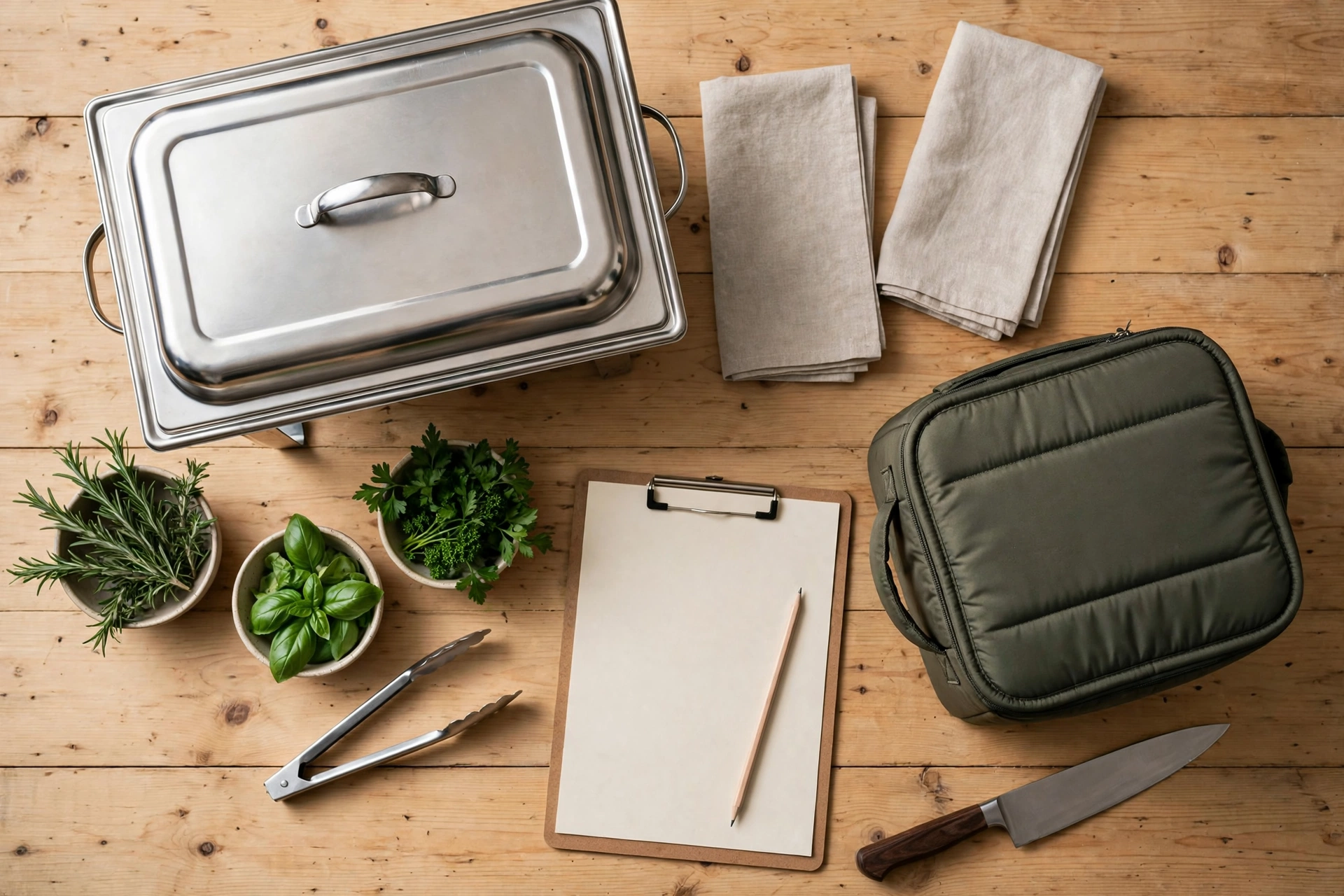
Step 7 — Build your catering equipment list
A good fit-out is about workflow, not gadgets. Start your catering equipment list with the things your menu cannot live without — chafing dishes or hot-holding cabinets, refrigeration, freezer space, prep counters, a handwash station and insulated carriers — and add everything else only after those are settled. Every item must earn its space, because a catering kitchen is measured in metres and every wasted corner slows down service.
Work through the list with a cook’s eye. Can two people pass each other without bumping? Is the raw food stored below the ready-to-eat food? Does the transport fit everything without stacking hot boxes on cold boxes? Your equipment list should also include the unglamorous items beginners forget: serving spoons, labels, allergen cards, cleaning supplies, first aid kit and a spare set of everything that breaks most often. Label every box, keep a printed copy of the list in the van, and count kit back in after every event — lost serving dishes are a quiet profit leak that adds up over a season.
Step 8 — Design a menu that travels well
Your menu is the heart of your catering business — it defines your brand, shapes your costs and determines your profit. The best catering menus are built around dishes that travel well: food that holds its temperature, keeps its texture in a hot box and still looks beautiful on a plate an hour after it leaves your kitchen. Delicate fried food, fussy plating and anything that wilts in transit will embarrass you at the venue, so design for the journey, not just the kitchen.
Offer a short starter menu of three options per course rather than twenty dishes. A short menu is faster to cook, cheaper to stock and easier for clients to choose from, and it lets you perfect every dish instead of being average at all of them. Price per person, and learn to calculate your food cost percentage: the cost of ingredients divided by the selling price, times one hundred. A healthy food cost sits around 28–35% of your menu price, so a $40 per-person menu should cost you $11 to $14 in ingredients and packaging. If a dish costs more than that, either raise its price, simplify it or take it off the menu.
Step 9 — Price every plate for profit
Pricing is where passion meets arithmetic. Your margin depends on three numbers: food cost, labour and transport. Add service fees, staff charges and equipment rentals separately rather than hiding them in the food price, because clients compare per-person food prices first and accept clearly listed extras more easily than a mysteriously high headline price. Always quote in writing, with the menu, the guest count, the service style and the payment schedule spelled out.
Watch your numbers every week, not every quarter. Track your best sellers and your slowest dishes, and be honest about the slow ones: a dish that sells twice a month but needs its own ingredients and prep time is usually losing you money. Small price rises of a dollar or two per person, tested quietly, are far better than a sudden jump that shocks your regulars. And remember that your margin is made on ordinary weekday office lunches, not festival weekends — price for the Tuesday lunch crowd, and the big weddings become a bonus.
Step 10 — Win your first clients and grow
Clients come from trust, and trust comes from being seen doing good work. Your first bookings will usually come from people who already know your cooking: friends, family, colleagues and local groups. Offer your first three events at a fair price in exchange for honest feedback, photos and a written testimonial you can use. Then take those photos to the people who book caterers every week: wedding venues, event planners, office managers, hotels and community halls.
Learning how to start a catering business is mostly about learning how to keep clients, and the secret is reliability. Answer every enquiry the same day, send quotes within 24 hours, confirm every detail in writing, and arrive early with everything on your list. One missed delivery or one cold main course can cost you a venue relationship that took months to build. Once you have ten happy clients, ask each one for a referral and a review. Regularity builds regulars, and regulars are the cheapest marketing a caterer will ever have.
What a catering business can actually earn
So what does all this add up to in real money? A small drop-off caterer doing office lunches can turn over $3,000 to $8,000 a month in the first year, while a full-service caterer with weddings and corporate events can turn over $15,000 to $40,000 a month in a busy season. Over a year, a well-run single-team operation commonly turns over $100,000 to $300,000, and a strong operator keeps 10–20% of that as profit after all costs — which brings us back to the question this guide started with: how to start a catering business, and is it worth it? The answer depends on your model: start lean from a shared kitchen and a $15,000 annual profit is a solid return; spend $100,000 on a full setup and you need far bigger sales to earn the same return.
Weddings lift the numbers further, because the average wedding catering cost runs to $70–$100 per person or more, and a single 150-guest wedding can be worth a whole month of office lunches with far less waste. Many caterers find weddings become a third of their income within two years, and they are the most reliable way to fill quiet winter weekends. The honest picture is that catering is a real business with real costs and real profits — not a shortcut to easy money, but a genuine living for owners who watch their numbers and keep showing up.
6 mistakes new caterers make
- Cooking a menu that cannot travel. A dish that is perfect in your kitchen and sad in a hot box will cost you a client. Test every dish after an hour in transit, not just fresh off the stove.
- Forgetting the cash reserve. Three months of running costs in the bank is not caution, it is survival. Kitchens break, winters are quiet and events cancel.
- A menu that is too long. Twenty dishes means twenty sets of ingredients, slower service and more waste. Five great dishes beat twenty average ones.
- Skipping insurance. Some caterers trade for months without proper cover, then one food-poisoning claim or one accident ends the business overnight.
- Pricing by guessing. If you have never worked out your food cost per dish, you are guessing — and most guesses are too low. Price from your costs, not from what feels fair.
- Vanishing after the event. No follow-up, no photos, no thank-you note and no request for a review. The event ends, and so does the relationship — along with the referral that would have followed.
Frequently asked questions
What does it cost to start a catering business?
For most first-time owners, what it costs to start a catering business comes to $5,000–$20,000 for a lean home-based or shared-kitchen setup, and $50,000–$100,000 or more for a full-service operation with its own kitchen, staff and transport. The kitchen, equipment, licences and insurance are the biggest lines, and a cash reserve of three months of running costs should sit on top of them.
Can I run a catering business from my home kitchen?
It depends on your local rules. Some areas permit limited home catering under cottage food or home kitchen rules, while most require a licensed commercial or shared kitchen. The question of how to start a catering business from home is best answered by your local health department — ask them in writing before you spend anything, and if home cooking is not allowed, a shared kitchen is the usual low-cost route.
Do I need a food handler certificate?
Yes, in almost every US city and county, at least one person preparing food must hold a food handler or food manager certificate. The course usually takes a day and costs very little, and your health inspection will ask to see it.
How much can a catering business make in a month?
A small drop-off caterer can make $3,000 to $8,000 a month in sales in the first year, while a full-service caterer with weddings and corporate events can make $15,000 to $40,000 a month in a busy season. Your monthly take depends on your niche, your prices, your event count and how fast you can serve — speed and reliability are often the difference between a good month and a great one.
What is the average wedding catering cost?
In the US it usually falls between $70 and $100 per person for a standard buffet or plated service, and higher for premium menus, open bars and full staffing. The final figure depends on the guest count, the menu, the service style and the venue, so always quote per person in writing with every extra listed separately.
What is the hardest part of running a catering business?
Most owners say it is the logistics: early mornings, prep, packing, driving, setting up, serving, cleaning and restocking, often with a small team and a tight timetable. The cooking is the fun part; the routine around it is the real job, and it is what wears people out.
How do I find my first catering clients?
Start with people who already know your cooking, then take your photos and testimonials to wedding venues, event planners, office managers and hotels. Answer every enquiry the same day, send quotes within 24 hours and confirm every detail in writing. One happy client who refers you to a venue is worth more than a month of advertising.
Can I run a catering business part-time?
Yes, many caterers start at weekends and evenings around another job, especially with drop-off orders and small private parties. Part-time catering works best with a short menu and one or two regular clients, and it is a sensible way to test the business before going full-time.
Final Word
Catering is one of the most satisfying small businesses you can start — real food, real people, real celebrations that you helped make happen. That is how to start a catering business that lasts: one good event at a time. But it rewards owners who respect the numbers: the kitchen, the costs, the licences and the daily routine. Work out your budget honestly, test your menu before you book, keep your menu short and your service reliable, and show up where your clients expect you. Do that, and the kitchen stops being a dream and starts being a living.

From Kitchen to Clients: How to Start a Catering Business

On Wheels: How Much Does It Cost to Start a Food Truck

Design to Dollars: How to Start a Home Staging Business

Launch Guide: How to Start an Appliance Repair Business

Solar Panel Installation Business Plan: A Launch Guide

Window Installation Cost Per Window: Launch Your Business

Siding Installation Companies: Launch Your Siding Business

Patio Installation Services: Start Your Own Patio Business

Deck Building Services: Run Your Own Deck Building Business

Tile Installation Services: Start Your Own Tiling Business

How to Repurpose Blog Content for Social Media Without Starting From Scratch

How to Get More Clients for Your Business: Simple Ways That Actually Work

How to Write a Simple Business Plan for Your Small Business: A Practical Guide That Gets You Started

How to Write a Professional Business Email That Gets a Reply

How to Create a Small Business Content Marketing Plan That Actually Gets Results
How to Handle Customer Complaints in a Small Business: A Calm, Practical Guide That Turns Problems Into Loyalty
How to Create a Content Calendar for a Small Business

Branding Tips for Small Businesses: A Simple Guide That Makes You Memorable
How to Set Up a Simple Referral Program for Your Small Business: A Beginner’s Guide That Brings in New Customers

How to Set SMART Goals for a Small Business: A Practical Guide That Actually Works
From Kitchen to Clients: How to Start a Catering Business
On Wheels: How Much Does It Cost to Start a Food Truck
Design to Dollars: How to Start a Home Staging Business
Launch Guide: How to Start an Appliance Repair Business
Solar Panel Installation Business Plan: A Launch Guide
Window Installation Cost Per Window: Launch Your Business
Siding Installation Companies: Launch Your Siding Business
Patio Installation Services: Start Your Own Patio Business
Deck Building Services: Run Your Own Deck Building Business
Tile Installation Services: Start Your Own Tiling Business

 entertainment1 year ago
PYT Telegram: A Complete Guide to Understanding, Using, and Maximizing It

 entertainment1 year ago
OnionFlix: Everything You Need to Know About This Streaming Website
- education1 year ago
How to Become a Software Engineer: A Complete Guide
- entertainment10 months ago
Brainrot Memes: The Unhinged Humor of the Internet Generation