business
Quarters to Cash Flow: Your Laundromat Business Plan

Intro
A laundromat is one of the few businesses that earns money while you sleep. The machines do the work, customers pay before they wash, and demand stays steady in any neighbourhood where people rent their homes. That is exactly why so many first-time owners pick it — and why so many of them also run into trouble. The difference between a store that hums along for twenty years and one that bleeds cash is rarely luck. It is the plan behind it.
If you want to learn how to start a laundromat business the right way, you need more than a love of clean laundry. You need a clear laundromat business plan that answers the hard questions before you sign anything: who your customers are, what the real costs look like, where the money comes from, and how you will stand out from the tired store two streets away. This guide walks through all ten steps, from choosing your model to opening day, plus what the business can earn and the mistakes that sink new owners.
Step 1: Decide What Kind of Laundromat You Will Run
Before you look at a single property, decide on the model. The classic self-service store — rows of coin or card-operated washers and dryers — is the simplest to run and the cheapest to staff. Customers wash their own clothes, you keep the machines clean and working, and the income is mostly hands-off.
But the classic model is not the only one. Wash-and-fold service, where customers drop off a bag and collect it clean and folded, earns far more per kilo and builds loyal repeat customers. Pickup and delivery adds another layer: a driver collects bags from homes and offices and returns them the next day. Many owners combine two or three of these laundromat business ideas in one store, using the self-service floor to cover the rent and the services to drive the profit.
Think about your street before you choose. A neighbourhood full of apartment blocks and students suits self-service. A busy area of working families and young professionals is perfect for wash-and-fold and delivery. Your model decides your machines, your staffing and your prices, so settle it first and let everything else follow.
Step 2: Research Your Market and Pick the Right Location
Location decides a laundromat more than almost any other business. People choose the nearest clean, safe store, so your trade area is really just the streets around you. Walk the neighbourhood at different times of day. Count the apartment buildings, count the renters, and notice how many homes have no in-unit washer. A high share of renters is the strongest sign of demand you will find.
Visit every competing store within a few kilometres. Note their prices per load, their opening hours, the state of their machines and whether the place feels clean and safe at night. A shabby competitor with broken dryers is an opening, not a warning — it tells you customers are ready for something better.
Also check the practical side of any site you like: water pressure, drainage, gas supply, three-phase power, parking, and foot traffic. A cheap lease in a dead spot costs far more than a fair lease on a busy street. Talk to the local council early too, because some areas restrict water use or need extra permits for commercial laundry.
Step 3: Write Your Laundromat Business Plan
Every serious step after this one hangs on your written plan, so do not skip it. A good laundromat business plan is not a thick document full of jargon. It is a short, honest file that covers your model, your market, your costs, your prices and your break-even point. Lenders will ask for it, landlords will respect it, and you will use it every time a decision gets hard.
Start with the basics: who you serve, what services you offer, and what makes your store different. Then add the numbers. List every cost you expect — lease, machines, build-out, utilities, insurance, supplies, staffing and marketing — and the monthly revenue you need to cover them. Work out how many loads a day you must sell to break even, and be honest about how long it will take to get there.
Set a launch budget with a cushion of at least three months of running costs. Many new owners fail not because the idea was bad but because they ran out of cash in month four. Your plan should also name your funding sources, your pricing, and the month you expect the store to pay for itself. Review it every quarter once you open; a plan that never changes is a plan nobody reads.
Step 4: How Much Does It Cost to Start a Laundromat
This is the question every future owner asks first, and the honest answer is that it varies widely. If you are wondering how much does it cost to start a laundromat, the range for a new build commonly runs from around $200,000 to $500,000, and a full scratch build with new machines and a full fit-out can reach $700,000 to $1 million. Buying an existing store is usually cheaper, because the machines, plumbing and customer base are already there — but you inherit whatever wear and reputation come with them.
The biggest single cost is the machines. Commercial washers and dryers are built to run all day, every day, and a full set for a mid-size store can easily cost $100,000 to $300,000. Then comes the build-out: plumbing, drainage, gas lines, dryer venting, electrical work, flooring, lighting, seating and folding tables, which often adds $20,000 to $100,000 more.
Your laundromat startup cost also includes the lease deposit, permits, insurance, signage, a payment system, initial detergent and supplies, and working capital to survive the first slow months. Build your budget from real supplier quotes, not from a blog post, and add a 10 to 15 percent cushion for the surprises every build throws up.
Step 5: Line Up Laundromat Financing
Few people pay for a laundromat from savings alone, so financing is part of the plan from the start. Your laundromat startup cost decides how much you need to borrow, so get real supplier quotes before you talk to any lender. The most common route is an SBA loan, which suits this kind of business because the machines themselves act as collateral and the revenue is steady. Banks like laundromats for exactly that reason, as long as your plan and your credit are solid.
Equipment financing is the second route. Many machine distributors offer finance or leasing tied directly to the washers and dryers, sometimes with little money down, and seller financing is common when you buy an existing store — the current owner takes payment over a few years from the store’s own income. For laundromat financing, compare the total cost of each option, not just the monthly payment, and check whether the loan allows an early payoff.
Whatever route you take, do not borrow to the last dollar. Keep a cash reserve for repairs, because a row of dead machines on a Saturday is lost income you never get back. And if the numbers only work with a loan you can barely afford, the site is wrong, not the loan — walk away and find a better one.
Step 6: Find the Right Spot and Sign the Lease
By now you know your model, your market and your budget, so it is time to choose the site. Look for a ground-floor unit on a busy street near apartments, with parking and good visibility. Corner units work well because customers can spot you from two directions, and a spot near a grocery store or a bus stop brings steady passing trade.
Negotiate the lease like the long-term commitment it is. Laundromats need long leases — often ten years with renewal options — because your machines and plumbing stay put for years. Push for a rent-free fit-out period, a cap on annual rent rises, and the right to assign the lease if you ever sell. Get a solicitor to read the lease before you sign, and check who pays for what: roof repairs, water damage, and the cost of bringing old plumbing up to standard.
Before you commit, walk the street on a weekday morning, a Saturday afternoon and a Friday evening. The right site feels busy at all three times. If the street is empty at two of them, keep looking — the cheapest rent in town is still too expensive if nobody walks past.

Step 7: Register, Licences and Permits
Once the site is set, make the business legal. Register your company or sole proprietorship, get a tax number, and open a business bank account so your money never mixes with your personal cash. Then work through the permits. A laundromat business license is usually required by your local authority, and you may also need building and plumbing permits for the fit-out, a fire department sign-off for the dryers, a signage permit, and a wastewater discharge permit where the council asks for one.
Rules vary a lot by city, so ask the council for its full checklist rather than guessing. A laundromat business license application can take weeks, so start it while the build-out is under way, not after. Keep copies of every approval in one folder — inspectors, insurers and lenders all ask for the same papers.
Protect the store with insurance from day one. Laundromat insurance should cover the building and machines, public liability for slips and falls, and loss of income if a flood or fire closes you for a month. Read the policy for flood and water damage exclusions, because water is the one risk every laundromat lives with. A good broker who knows commercial property will save you from buying cover that does not actually cover you.
Step 8: Choose Machines and Set Up the Store
Your machines are the business, so choose them with care. Mix large and small washers — big machines for families and bedding, smaller ones for singles — and match dryer capacity to washer capacity so customers are not queuing with wet laundry. Buy from a supplier who services what they sell, because a machine that waits two weeks for a part is a machine that earns nothing.
Think about payment from the start. Card and app payments are now the norm in most new stores, and they cut theft, speed up the wash cycle, and let you change prices without reprogramming coin boxes. Add a change machine and clear price boards for customers who still pay cash.
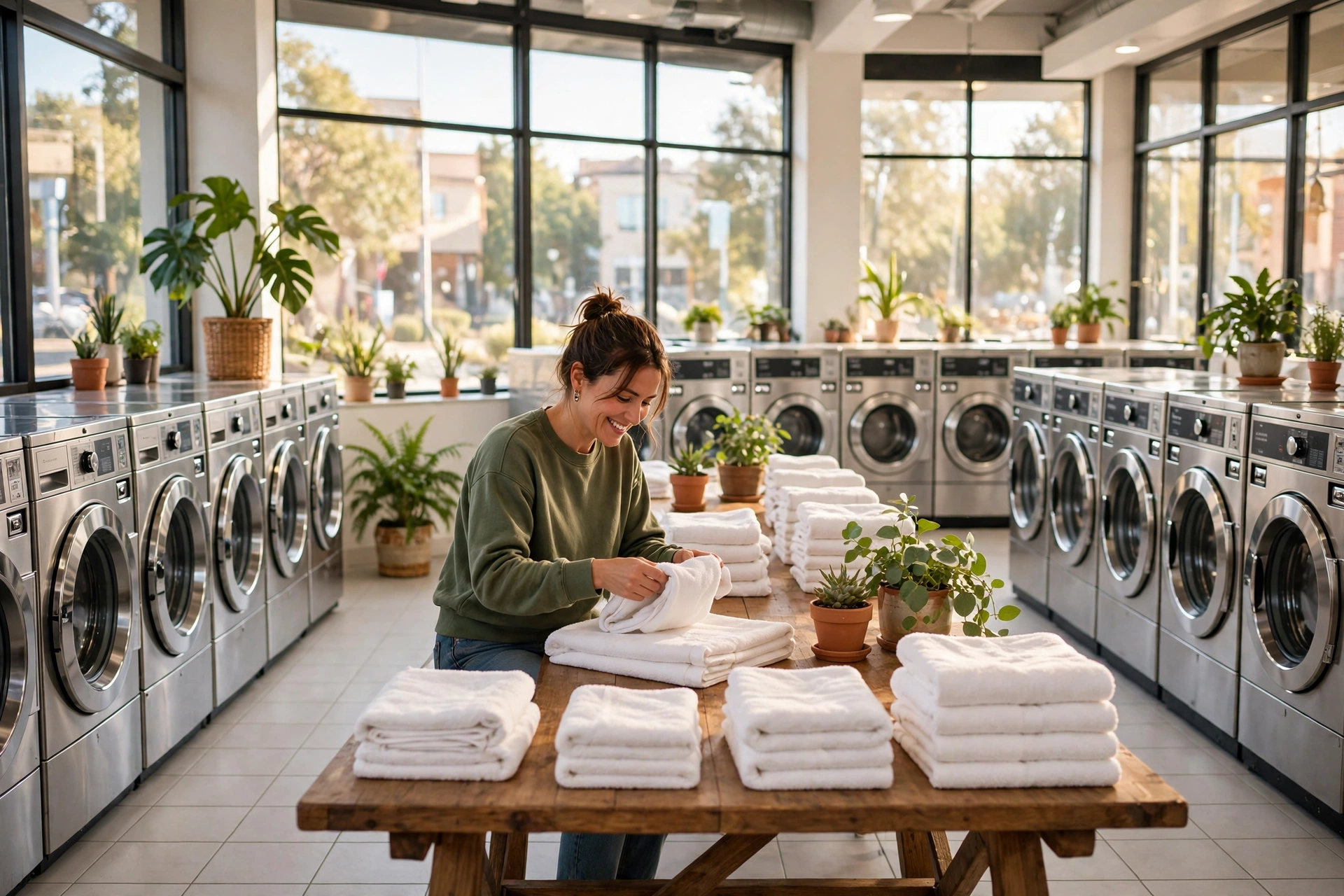
Design the store for comfort, because comfort is what brings people back. Bright light, clean floors, sturdy folding tables, seating, free Wi-Fi, and a clear view of the machines from the door all matter. Keep the layout simple: washers along one wall, dryers along the other, folding tables in the middle, and a clear path for trolleys. A store that feels safe and clean at 9pm earns the evening trade your competitors lose.
Step 9: Set Your Laundromat Pricing
Pricing is where many new owners guess — and guessing is expensive. Start by checking what every competitor nearby charges per load, then set your laundromat pricing to match the market rather than undercut it. A store that opens 20 percent cheaper than everyone else attracts bargain hunters who leave the moment prices rise, and it trains customers to expect a price you cannot sustain.
Price by machine size, not by the load. A 20kg washer should cost clearly more than a 10kg one, and dryers should charge by time so heavy loads pay their fair share. Wash-and-fold should be priced per kilo with a minimum charge, and delivery needs a minimum order and a delivery fee that covers the driver’s time.
Review your prices every six months. Utility costs move, and a store that never raises prices slowly earns less each year. Small, regular rises of a few percent are barely noticed by customers, while one big jump after three years feels like a shock. And always display prices clearly at the door and on every machine — hidden prices are the fastest way to lose trust.
Step 10: Open, Win Customers and Grow
Opening day is the start, not the finish. Offer a simple launch deal — a free dry with every wash for the first two weeks, for example — and hand a loyalty card to every customer who walks in. The goal is not a busy first weekend; it is a list of regulars who come back every week without thinking about it.
Spread the word where your customers actually are. A Google Business Profile with photos, hours and reviews is the single most useful tool, because most people search for a laundromat on their phone while standing in their kitchen. Add flyers in nearby apartment blocks, a small opening offer on local community pages, and a referral deal that rewards customers for bringing a neighbour.
Grow by adding services once the self-service floor is steady. Wash-and-fold, pickup and delivery, ironing, and contracts with nearby hotels, gyms, salons and restaurants all add revenue without new machines. These extra laundromat business ideas turn a good store into a great one, because a customer who uses two of your services is far harder for a competitor to steal than one who uses a single washer.
What a Laundromat Can Earn
So what does the money actually look like? A mid-size store in a good spot often takes in $5,000 to $40,000 a month in gross revenue, depending on size, location and services. Self-service alone gives the thinnest returns, while wash-and-fold and delivery lift the average ticket sharply. The laundromat profit margin for a well-run store commonly sits between 20 and 35 percent, which is strong for a small business — but only if the machines stay full and the costs stay controlled.
The laundromat profit margin depends on three things: how busy the machines are, what you pay for utilities, and how much you spend on repairs. Water, gas and electricity are your biggest running costs, so efficient machines pay for themselves faster than cheap ones. Track your revenue per machine per day, and you will quickly see which machines earn their keep and which ones just take up floor space.
Be realistic about the first year. Laundromat insurance is a fixed cost you cannot skip, so price it into your monthly break-even from the start. A new store takes months to build a regular customer base, and the first six months are usually the thinnest. That is why your plan carries a cash cushion, and why the owners who survive are the ones who budget for a slow start instead of hoping for a busy one.
6 Mistakes That Sink New Laundromat Owners
1. Skipping the market research. Opening where you live, rather than where the renters are, is the most common mistake of all. Demand comes from people without washers at home, not from a street you happen to like.
2. Buying the cheapest machines. A bargain washer that breaks every month costs more than a good one in its first year. Factor in repair bills and lost income, not just the sticker price.
3. Under-pricing to win customers. Cheap prices fill the store with people who leave when prices rise. Price fairly from day one and compete on clean machines and good service instead.
4. Ignoring the lease. A short lease, a steep rent rise, or a ban on assigning the lease can end a good business overnight. Read it, negotiate it, and get advice before you sign.
5. Forgetting the unglamorous costs. Water, gas, power, insurance, repairs and supplies add up fast. Owners who budget only for rent and machines are always surprised in month three.
6. Opening and going quiet. A laundromat with no sign, no online listing and no launch offer is invisible. The first three months of marketing matter more than the next three years.
Frequently Asked Questions
Is a laundromat a good business to start?
Yes, for the right owner in the right spot. If you are weighing up how to start a laundromat business, the short answer is that demand is steady, customers pay upfront, and the work is mostly managing machines and people rather than making a product. It suits owners who like systems and routine, and who will keep the store clean and the machines working.
How long does it take to open a laundromat?
From signing a lease to opening day, most owners need three to six months. The build-out — plumbing, drainage, gas, venting and electrical work — takes the longest, and permits can add weeks. Buying an existing store is faster, often four to eight weeks.
Do I need experience to run a laundromat?
No formal experience is required, and many owners start with none. What matters more is a willingness to learn the machines, keep the store clean, and talk to customers. A short course or a few weeks working in a friend’s store will teach you more than any book.
How many machines does a new laundromat need?
A small store can start with around 15 to 20 washers and a matching row of dryers, mixing sizes so families and single customers are both served. The exact number depends on your floor space and your budget, but it is better to start with fewer good machines than a full row of cheap ones.
What licences do I need for a laundromat?
You will usually need a business licence from your local authority, plus building and plumbing permits for the fit-out, and possibly fire and wastewater approvals. Rules vary by city, so ask the council for its full checklist before you start spending.
Can I run a laundromat part-time?
Yes, and many owners do. A self-service store with card payments and a part-time attendant can run on a few hours a week once it is set up, especially if you use remote monitoring for the machines. Wash-and-fold and delivery need more of your time, so add those services only when you are ready.
How do I get my first customers?
Start with the street around you: a clear sign, a Google Business Profile, flyers in nearby flats, and a simple opening offer. Then keep them with clean machines, fair prices and a store that feels safe at night. Word of mouth in a neighbourhood does the rest.
What is the biggest risk in a laundromat?
The biggest risk is a bad location. A store on a quiet street with few renters will struggle no matter how good the machines are. The second risk is running out of cash before the customer base builds, which is why your plan carries a three-month cushion.
Final Word
A laundromat rewards patience more than brilliance. The owners who do well are not the ones with the flashiest store; they are the ones who picked the right street, wrote an honest plan, bought machines that last, and kept the place clean every single day. If you follow the steps in this guide and treat your laundromat business plan as a living document rather than a one-time chore, you give yourself the best possible start.
Start small, watch the numbers weekly, and let the store grow at the pace your customers set. The washers will do the heavy lifting — your job is to make sure they never stop.

Quarters to Cash Flow: Your Laundromat Business Plan

From Kitchen to Clients: How to Start a Catering Business

On Wheels: How Much Does It Cost to Start a Food Truck

Design to Dollars: How to Start a Home Staging Business

Launch Guide: How to Start an Appliance Repair Business

Solar Panel Installation Business Plan: A Launch Guide

Window Installation Cost Per Window: Launch Your Business

Siding Installation Companies: Launch Your Siding Business

Patio Installation Services: Start Your Own Patio Business

Deck Building Services: Run Your Own Deck Building Business

How to Repurpose Blog Content for Social Media Without Starting From Scratch

How to Get More Clients for Your Business: Simple Ways That Actually Work

How to Write a Professional Business Email That Gets a Reply

How to Write a Simple Business Plan for Your Small Business: A Practical Guide That Gets You Started

How to Create a Small Business Content Marketing Plan That Actually Gets Results
How to Handle Customer Complaints in a Small Business: A Calm, Practical Guide That Turns Problems Into Loyalty
How to Create a Content Calendar for a Small Business

Branding Tips for Small Businesses: A Simple Guide That Makes You Memorable
How to Set Up a Simple Referral Program for Your Small Business: A Beginner’s Guide That Brings in New Customers

How to Set SMART Goals for a Small Business: A Practical Guide That Actually Works
Quarters to Cash Flow: Your Laundromat Business Plan
From Kitchen to Clients: How to Start a Catering Business
On Wheels: How Much Does It Cost to Start a Food Truck
Design to Dollars: How to Start a Home Staging Business
Launch Guide: How to Start an Appliance Repair Business
Solar Panel Installation Business Plan: A Launch Guide
Window Installation Cost Per Window: Launch Your Business
Siding Installation Companies: Launch Your Siding Business
Patio Installation Services: Start Your Own Patio Business
Deck Building Services: Run Your Own Deck Building Business

 entertainment1 year ago
PYT Telegram: A Complete Guide to Understanding, Using, and Maximizing It

 entertainment1 year ago
OnionFlix: Everything You Need to Know About This Streaming Website
- education1 year ago
How to Become a Software Engineer: A Complete Guide
- entertainment10 months ago
Brainrot Memes: The Unhinged Humor of the Internet Generation