business
Driveway Dollars: How to Start a Mobile Car Wash Business

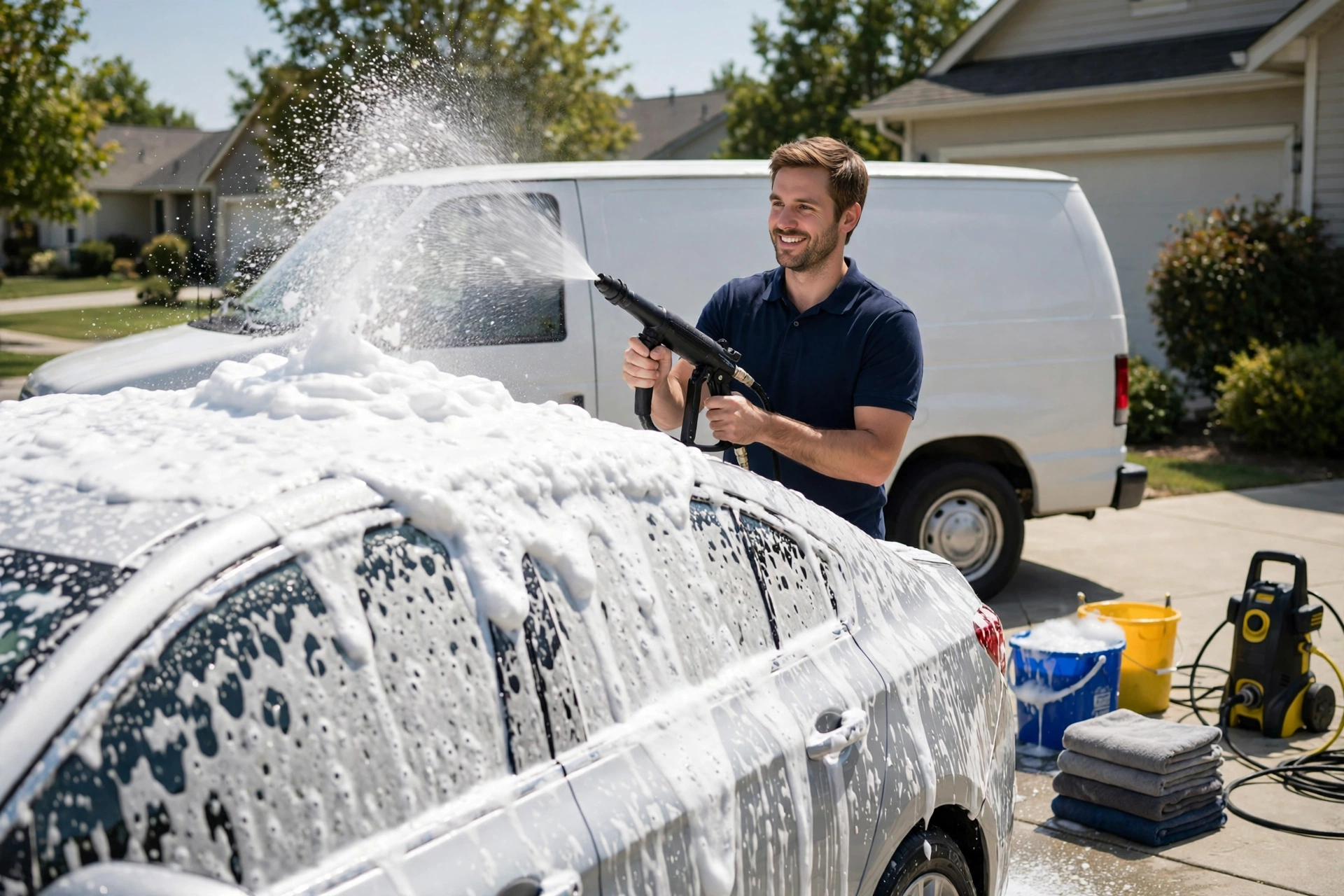
A dirty car is a small problem most owners keep putting off. They mean to visit the car wash, then the week slips away, the kids need collecting, and the dust stays put. That is exactly why a mobile wash works: you bring the clean to the customer, at their home or their office, while they get on with their day. If you like working outdoors, driving around your town, and seeing a visible result at the end of every job, learning how to start a mobile car wash business is one of the lowest-cost ways into self-employment.
You do not need a building, a lease, or a big loan. If you have ever looked up how to start a car wash business and felt put off by the cost of a fixed site, the mobile route removes the biggest barrier: rent. A reliable vehicle, a water tank, a pressure washer, and a tidy set of supplies are enough to take your first paying booking. The work is physical and the days are weather-dependent, but the margins are honest and repeat customers come back every two to four weeks. This guide walks through the whole launch in thirteen practical steps, from your first market check to your first fleet contract.
Step 1: Research Your Local Market Before You Buy Anything
Every good launch starts with looking, not spending. Drive through the neighbourhoods you plan to serve and count the clues: rows of parked cars outside offices, apartment blocks with dusty vehicles, busy retail parks, and trades vans that never look clean. Those are your customers. Then search for existing mobile washers in your area and read their reviews. Note what they charge, which services they push, and what customers complain about — slow replies and missed appointments are the complaints you will beat them on.
Talk to people too. Ask ten car owners whether they would pay for a wash at their driveway and what would stop them: price, trust, or water running onto the pavement. In many towns the answer is encouraging, because the fixed car wash is a chore and the driveway wash is a convenience. Write down the three busiest areas, the going rates, and the gaps — maybe nobody offers evening slots, or nobody serves the industrial estate. That short note is the foundation of everything that follows.
Step 2: Pick Your Services and Your Customers
A mobile wash can mean many things, so decide yours early. The simplest menu of mobile car wash services has three rungs: an exterior wash, an exterior-plus-interior clean, and a full valet with wax and wheel care. Each rung takes a predictable amount of time, which makes pricing and scheduling easy. Add extras — pet hair removal, leather conditioning, engine bay wipe-downs — as paid add-ons rather than standard items, so your base prices stay attractive. A few fresh ideas for standing out are evening slots, a monthly plan, and a weekly fleet day for local offices. That menu is the product at the heart of how to start a mobile car wash business in your town.
Then choose who you serve first. Commuters who want a wash while they work, parents who want the family car cleaned on the driveway, and small businesses with a handful of vans are all strong starting points. A few early regulars matter more than a long list of one-off jobs, because regulars let you plan routes and buy supplies in bulk. One well-chosen customer group, served brilliantly, beats a scattered approach every time.
Step 3: Write a Simple Mobile Car Wash Business Plan
A plan does not need to be a fifty-page document. One page is enough if it answers the real questions: who are your customers, what will you charge, what will it cost to run, and how will you find work. Your mobile car wash business plan should list your three service packages, your prices, your weekly target for jobs, and the monthly costs of fuel, water, chemicals, insurance, and phone. When those numbers sit side by side, you can see at a glance whether the idea pays.
The plan also forces honest decisions. If the numbers only work at forty jobs a week, you know the launch needs a strong first month of promotion. If they work at fifteen, you can start part-time around another job. Revisit the plan every month for the first year and update the prices and targets as real figures replace guesses. A plan that lives on the fridge is worth more than a plan that lives in a drawer.
Step 4: Work Out What It Really Costs to Launch
The most common question new owners ask is what the launch really costs, and the honest answer is that it depends on the vehicle. If you already own a suitable van or pickup, a lean setup — water tank, pressure washer, generator, vacuum, hoses, chemicals, and towels — can come in around $2,000 to $5,000. If you need to buy a used van as well, expect $10,000 to $25,000 all in. Buying second-hand gear from a retiring washer can cut that figure sharply, so check local classifieds before buying new.
Your launch budget is not only the gear. Add registration, mobile car wash insurance, a business licence, a phone, a booking system, and your first month of fuel and supplies, plus a small reserve for repairs. The second time people ask about launch costs, they usually mean the running costs — and those are modest: roughly $5 to $10 of water, chemicals, and fuel per car on a standard wash. Keep a simple spreadsheet of every pound spent in month one, because knowing your true launch budget is what lets you price with confidence instead of guessing.
Step 5: Choose Your Vehicle and Water System
Your vehicle is your workshop, so choose it like one. A cargo van is the favourite because everything stays dry, locked, and organised, and the van itself becomes a moving billboard. A pickup with a trailer works too and costs less to start, but loading and unloading in the rain gets old fast. Whatever you pick, make sure it can legally carry a full water tank — water is heavy, and an overloaded van is a safety problem and a fine waiting to happen.
The water system is the heart of the rig: a baffled tank of 100 to 250 gallons stops water sloshing around corners, a pump feeds your pressure washer, and a generator powers the vacuum when no mains socket is available. Some operators collect the customer’s water instead, which saves tank weight but depends on every customer having an outdoor tap. Carry your own water and you can wash anywhere, which is the whole point of being mobile. Test the full setup on your own car twice before your first paid job, and time it — you are learning your real job duration, not guessing it.
Step 6: Gather Your Wash Gear and Supplies
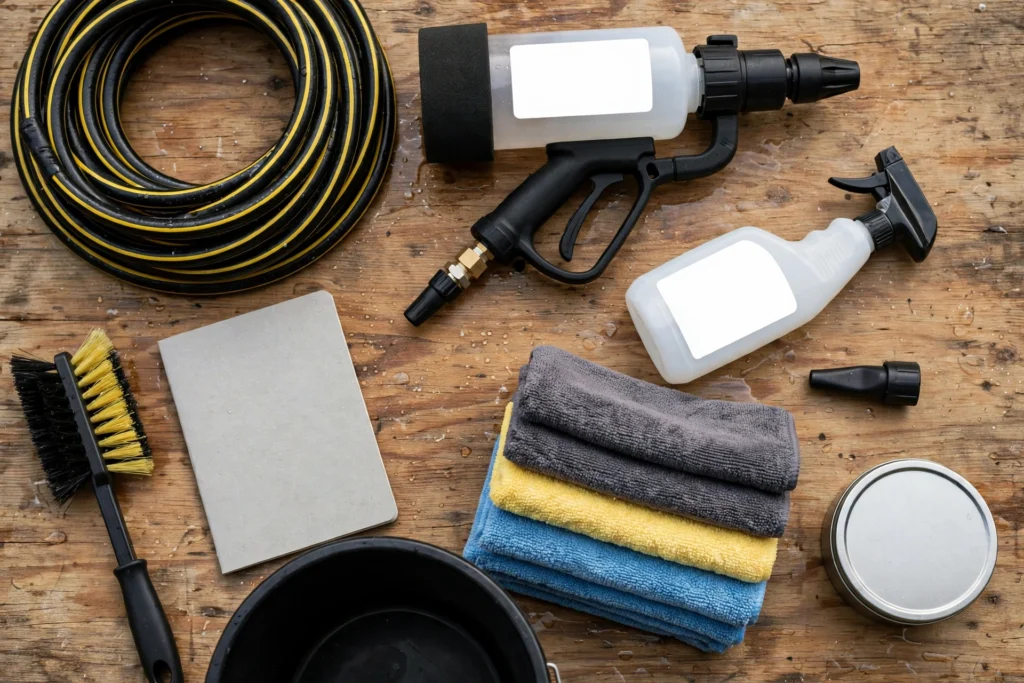
Good gear earns its keep in speed and finish. Your mobile car wash equipment list starts with a pressure washer with adjustable nozzles, a foam cannon, two buckets with grit guards, a stack of clean microfiber towels, a wet-and-dry vacuum, wheel brushes, glass cleaner, and a pH-neutral shampoo that is safe on paint and kind to driveways. Buy chemicals in bulk once you know which ones you like, and keep a second set of towels in rotation so you never dry a car with a dirty cloth.
Storage matters as much as the gear itself. Shelving or crates that stop bottles tipping over, a hose reel that winds in thirty seconds, and a labelled box for each service level will save you minutes on every job — and minutes are money when you do four or five cars a day. Photograph your kit laid out neatly before launch; that photo doubles as a social media post and a reminder of what “ready” looks like when you restock.
Step 7: Register, License and Insure the Business
Paperwork is dull, but it is what separates a business from a hobby. Register your business structure — most mobile washers choose an LLC for the liability protection — get a tax number, and open a separate business bank account so personal and business money never mix. Then check the local rules: many councils ask for a general business licence, and some restrict where wash water can run off, especially near drains and waterways. A quick call to your local authority is cheaper than a fine.
Insurance is non-negotiable. General liability cover protects you if you scratch paint or damage a driveway, and commercial vehicle cover is needed because a personal policy often excludes business use. Your licence may also come with conditions, such as carrying proof of insurance in the van, so read the fine print and keep copies in the glovebox. Ask your insurer directly whether mobile car wash insurance covers water damage and chemical spills, and get the answer in writing. A licensed, insured operator wins corporate and fleet work that uninsured washers cannot touch, so treat this step as a sales tool, not just a chore.
Step 8: Pick a Business Name and Brand People Remember
Your name travels on the side of your van, so make it easy to say, spell, and search. Short names with a local flavour work well — think of the town, the speed, or the shine — and avoid words that are hard to spell over the phone. Before you print anything, check the name is free as a domain and on social media, and make sure no other washer nearby already uses it. Good names are simple enough for a customer to remember after seeing your van once at a traffic light.
Once the name is settled, keep the brand consistent: one colour scheme, one logo, matching van signage, invoices, and a Google Business Profile with real photos of your work. A strong name does half the promotion for you, because a neighbour who sees a clean car and a tidy van will ask who did it. Add a short slogan about convenience — “we come to you” — and put your phone number where it can be read from ten feet away.
Step 9: Set Your Packages and Rates
Pricing a wash is really pricing your time. Time three full jobs from arrival to departure, add fuel and supplies, and you have your true cost per car. Most mobile washers charge more than a fixed car wash because the customer pays for convenience, and that is fair: they save the drive, the queue, and the wait. Publish three clear packages with prices by vehicle size — cars cheaper than SUVs and vans — and list add-ons separately so customers can build their own clean.
Set your rates with confidence and review them after your first twenty jobs. If you are booked out two weeks ahead, your prices are too low; if enquiries stall after the quote, test a smaller starter package rather than discounting everything. Keep price setting simple and visible on your website and booking page — hidden prices cost you enquiries. A rate card that a customer understands in ten seconds is worth more than a clever one they have to decode.
Step 10: Book Your First Customers
The first ten customers are the hardest, so go where trust already exists. Offer a launch price to neighbours, colleagues, and local business owners, and ask every happy customer for a review and a referral. Leave a card under the wiper of freshly washed cars only with permission, and never on private property without asking. A Google Business Profile with photos, honest reviews, and a reply to every comment will do more for you than a paid advert in month one.
Promotion for a mobile wash is wonderfully local: a tidy van with your number on it, a stall at a community fair, a deal with a gym or office block for a weekly visit, and a simple booking page that takes thirty seconds to use. When people see how to start a mobile car wash business done well — on time, polite, and leaving no mess behind — they book again and tell a friend. Your first month’s goal is not profit, it is ten five-star reviews and five repeat bookings. Everything else grows from that base.
Step 11: Deliver a Wash Worth Rebooking
A great wash is a system, not a talent. Arrive on time, greet the customer, walk around the car together and note any existing marks, then work top to bottom: pre-rinse, foam, hand wash with two buckets, rinse, dry with clean towels, wheels and glass last. Vacuum the interior in straight lines, wipe the dash, and finish with a quick quality check before you call the customer out. The whole job should look calm and unhurried even when you are working fast.
The small touches are what get you rebooked: a tidy mat shake, a streak-free windscreen, a “thank you” text with a photo of the finished car, and no water left pooling on the driveway. Ask for feedback before you leave, and fix any complaint on the spot — a returned customer who saw you care is worth ten one-off jobs. Consistency is your brand promise: the tenth wash should look exactly as good as the first.
Step 12: Grow With Fleets, Subscriptions and Repeat Bookings
One-off washes pay the bills, but regular work builds the business. Offer a monthly plan — one wash a month at a small discount, paid in advance — and watch your income smooth out across wet and quiet weeks. Approach offices, estate agents, taxi firms, and delivery depots with a simple fleet offer: a fixed day each week, a set price per vehicle, and one monthly invoice. Fleet work fills your diary in blocks and cuts the driving between jobs. These approaches all share one trait: they turn one-off washes into repeat income.
As bookings grow, protect your time. Group jobs by area into morning and afternoon routes, leave gaps for traffic, and cap daily jobs at a number you can finish well rather than one that leaves you rushing. Hire your first helper only when you are turning work away three weeks in a row, and train them on your exact wash system so quality never depends on who holds the hose. Growth that keeps customers happy is growth that lasts.
Step 13: Decide Whether to Buy, Franchise or Scale Up
After a year of steady trading you will face a pleasant question: what next? One route is buying an existing round — a mobile car wash business for sale often comes with customers, a van, and a route, which can be cheaper than building from scratch. Check any listing carefully: ask for booking records, review the customer list, inspect the van and the tank, and value the business on its repeat customers, not its promises. A mobile car wash business for sale with a genuine waiting list is worth a premium; one with only a van and a logo is not.
A second route is a franchise, which trades independence for a proven brand and booking system. A mobile car wash franchise can suit an owner who wants training and marketing handled, but read the fees, the territory limits, and the exit terms before signing anything. You can also run the whole operation from home as a one-van setup for years — many owners do exactly that, keeping overheads low and profits high, with the van parked on the drive and the office a corner of the kitchen. If you later want to move upmarket, guides on how to start a mobile detailing business cover the premium end of the same trade, where interior restoration and paint care command higher tickets. Whichever path you choose, grow on the back of happy customers, not debt, and the business will stay yours in every sense that matters.
Frequently Asked Questions
Is this kind of business profitable?
It can be, because the overheads are low and the service is repeatable. A solo operator doing four cars a day at a healthy average ticket, five days a week, can cover costs and take a real wage once the diary is full. Profit depends on your prices, your route density, and how many customers rebook — so the first year is about building regulars, not chasing the highest possible daily total.
How much money do I need to launch?
A lean setup with a van you already own runs roughly $2,000 to $5,000 for the tank, washer, vacuum, and supplies. Add a used van and the total rises to $10,000 to $25,000. Monthly running costs are modest — fuel, water, chemicals, and insurance — usually a few hundred dollars once you are trading regularly.
Do I need a licence to wash cars at customers’ homes?
Rules vary by area, so check with your local authority before trading. Many places ask for a general business licence, and some restrict wash water runoff near drains. A quick call now avoids a fine later, and a licensed operator can bid for fleet and corporate work.
What equipment do I need to start?
The essentials are a vehicle, a baffled water tank, a pressure washer, a generator, a wet-and-dry vacuum, hoses, buckets, microfiber towels, and quality shampoo and wheel cleaner. Buy the best washer and vacuum you can afford — they are the tools you use on every single job.
Can I run this business from home?
Yes — most owners do. The van parks on the drive, supplies live in the garage, and bookings come through a phone and a simple website. Keep business money in a separate account and set aside a corner of the house as the office so paperwork never takes over the kitchen table.
How do I find my first customers?
Start with people who already trust you: neighbours, colleagues, and local businesses. Offer a launch price, collect reviews on your Google Business Profile, and let the van’s signage work for you. A weekly slot at an office car park can fill your diary faster than any advert.
Should I buy a franchise or start independently?
Starting independently costs less and leaves every decision with you, which suits most first-time owners. A mobile car wash franchise gives you a brand, training, and marketing, but charges fees and sets rules. Compare the total five-year cost of both routes before you decide — and talk to existing franchise owners, not just the sales team.
How many cars can one person wash in a day?
Four to six is a realistic, well-paced day, depending on service level and driving distance between jobs. A basic exterior wash takes 30 to 45 minutes; a full valet can take two hours. Route jobs by area and leave buffer time, because a rushed wash is the one that loses the repeat booking.
Final Word
Starting a mobile wash is not a shortcut to easy money — it is a real trade that rewards reliability, good work, and tidy habits. Keep your van clean, your towels fresh, your prices honest, and your promises small enough to keep every time. Do those four things for a year, and the diary fills itself. Your first customer is probably parked within a mile of your front door, wondering when their car will ever get cleaned. Now you know how to start a mobile car wash business — so be the person who turns up and does it.

Driveway Dollars: How to Start a Mobile Car Wash Business

Coins to Cash Flow: How to Start a Vending Machine Business

Soot to Success: How to Start a Chimney Sweep Business

Wrenches on Wheels: How to Start a Mobile Mechanic Business

Foundations First: How to Start a Home Inspection Business

Stamps on the Move: How to Start a Mobile Notary Business

Paws and Paychecks: How to Start a Pet Sitting Business

Vows to Ventures: How to Start a Wedding Planning Business

Bins to Business: How to Start a Dumpster Rental Business

Quarters to Cash Flow: Your Laundromat Business Plan

How to Get More Clients for Your Business: Simple Ways That Actually Work

How to Write a Simple Business Plan for Your Small Business: A Practical Guide That Gets You Started

Branding Tips for Small Businesses: A Simple Guide That Makes You Memorable

How to Start Freelancing With No Experience: A Simple Guide That Gets You Your First Client

How to Do a Small Business Competitive Analysis: A Simple Guide That Finds Your Edge

How to Create a Budget for a Small Business: A Simple Guide That Keeps Your Money in Order

How to Keep Customers Coming Back: Simple Ways That Actually Work

Christmas Marketing Ideas for Small Businesses: Simple Ways to Win Festive Customers

Networking Tips for Small Business Owners: A Simple Guide That Turns Conversations Into Customers

How to Promote Your Blog Posts: Simple Ways That Actually Work
Driveway Dollars: How to Start a Mobile Car Wash Business
Coins to Cash Flow: How to Start a Vending Machine Business
Soot to Success: How to Start a Chimney Sweep Business
Wrenches on Wheels: How to Start a Mobile Mechanic Business
Foundations First: How to Start a Home Inspection Business
Stamps on the Move: How to Start a Mobile Notary Business
Paws and Paychecks: How to Start a Pet Sitting Business
Vows to Ventures: How to Start a Wedding Planning Business
Bins to Business: How to Start a Dumpster Rental Business
Quarters to Cash Flow: Your Laundromat Business Plan

 entertainment1 year ago
PYT Telegram: A Complete Guide to Understanding, Using, and Maximizing It

 entertainment1 year ago
OnionFlix: Everything You Need to Know About This Streaming Website
- education1 year ago
How to Become a Software Engineer: A Complete Guide
- entertainment10 months ago
Brainrot Memes: The Unhinged Humor of the Internet Generation