Digital Marketing
Email Segmentation Strategy: Complete Guide to Improve Email Marketing Results in 2026

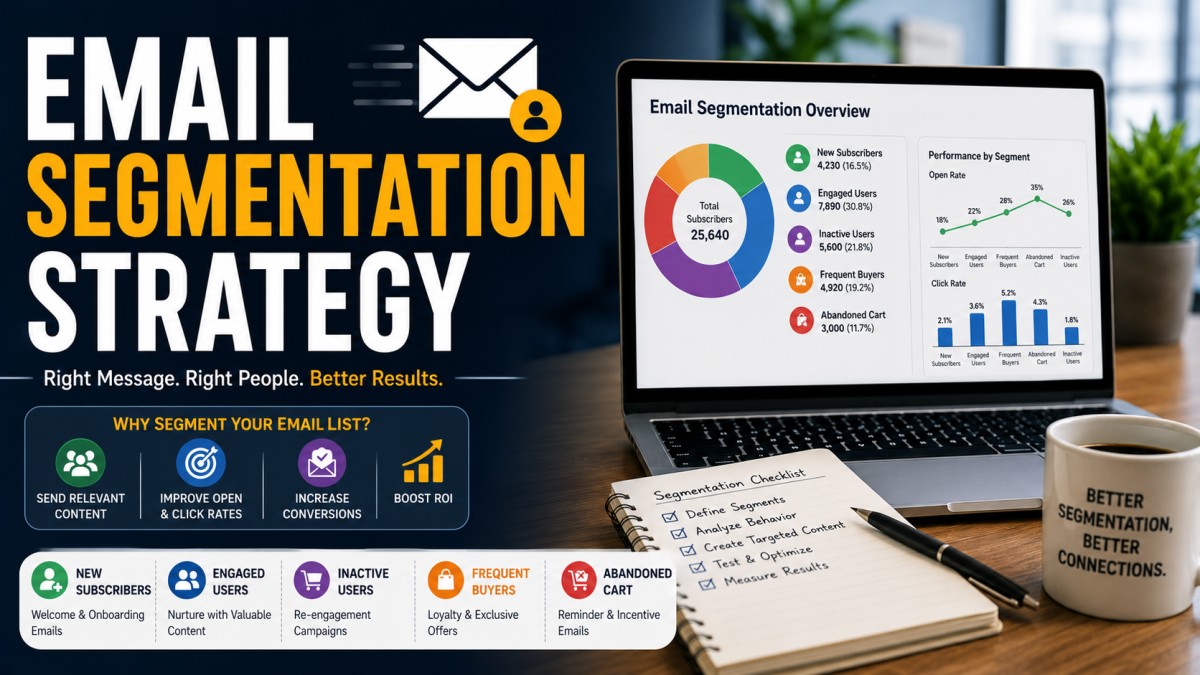
Email marketing remains one of the most effective digital marketing channels, but sending the same message to every subscriber rarely produces the best results. Modern businesses are focusing on personalization, and that’s where email segmentation strategy becomes essential. Whether you run an online store, a blog, or a service-based business, segmenting your email list can significantly improve engagement and conversions.
Understanding email segmentation strategy helps marketers send more relevant emails to the right audience. Instead of treating every subscriber the same, segmentation allows you to group people based on their interests, behavior, location, or purchase history. This creates a better customer experience and improves campaign performance.
The best part is that even small businesses can implement email segmentation without needing a large marketing team.
Email Segmentation Strategy: Why Segmentation Improves Campaign Performance
Learning email segmentation strategy begins with understanding that different subscribers have different needs. Someone who just joined your email list should not receive the same message as a loyal customer who has purchased multiple products.
The increasing importance of email segmentation strategy comes from the fact that personalized campaigns consistently achieve better open rates, click-through rates, and customer engagement. When subscribers receive emails that match their interests, they are more likely to interact with your content.
Relevant communication builds stronger customer relationships over time.
Segment by Subscriber Interests
One of the simplest methods is grouping subscribers according to what they are interested in.
Examples include:
- Blogging
- SEO
- Email marketing
- Online business
- Affiliate marketing
Relevant content improves engagement.
Segment Based on Purchase History
Previous purchases reveal customer preferences.
You can create separate groups for:
- First-time buyers
- Repeat customers
- High-value customers
- Inactive customers
This allows more personalized promotions.
Use Geographic Segmentation
Location-based campaigns often perform better.
You can segment subscribers by:
- Country
- State
- City
- Time zone
This is especially useful for location-specific offers.
Segment by Engagement Level
Some subscribers interact frequently while others rarely open emails.
Create segments such as:
- Active readers
- Occasional readers
- Inactive subscribers
Each group requires a different communication strategy.
Behavioral Segmentation
One of the most powerful email segmentation strategy techniques involves tracking subscriber behavior.
Examples include:
- Pages visited
- Products viewed
- Links clicked
- Download history
Behavior-based emails feel more personalized.
Segment New and Existing Subscribers
New subscribers often need educational content before receiving promotional offers.
Existing subscribers may respond better to:
- Product recommendations
- Loyalty rewards
- Exclusive discounts
Different stages require different messaging.
Personalize Email Content
Segmentation becomes more effective when combined with personalization.
Include:
- Subscriber names
- Relevant product suggestions
- Personalized offers
- Customized recommendations
Personalized emails usually generate higher engagement.
Automate Your Segments
Modern email platforms automatically update subscriber groups.
Automation helps:
- Save time
- Reduce manual work
- Improve consistency
- Deliver timely emails
Automation makes segmentation easier.
Test Different Segments
Not every segment performs the same.
Monitor:
- Open rates
- Click-through rates
- Conversion rates
- Unsubscribe rates
Testing helps identify the most effective strategy.
Common Segmentation Mistakes
Many marketers reduce campaign performance because they:
- Create too many unnecessary segments.
- Ignore subscriber behavior.
- Never update their lists.
- Send irrelevant content.
- Skip performance tracking.
Avoiding these mistakes improves long-term results.
Best Practices for Email Segmentation
Successful marketers usually:
- Keep segments simple.
- Update subscriber data regularly.
- Personalize messages.
- Monitor campaign performance.
- Use automation wisely.
- Focus on subscriber value.
- Test different approaches.
- Continuously optimize campaigns.
These habits improve email marketing success.
Benefits of Email Segmentation Strategy
Implementing segmentation offers several advantages.
These include:
- Higher open rates
- Better click-through rates
- Increased conversions
- Improved customer satisfaction
- Stronger long-term relationships
Relevant emails consistently outperform generic campaigns.
Helpful Email Marketing Platforms
Several tools support advanced segmentation.
Popular options include:
- Mailchimp
- ConvertKit
- Klaviyo
- Brevo
- ActiveCampaign
Most platforms provide automation and reporting features.
Future of Email Segmentation
Email marketing continues evolving through:
- AI-powered personalization
- Predictive customer behavior
- Advanced automation
- Dynamic content
- Smarter audience targeting
Businesses adopting these technologies will likely achieve stronger marketing results.
Conclusion
Building an effective email segmentation strategy is one of the smartest ways to improve email marketing performance in 2026.
Instead of sending identical emails to every subscriber, businesses can create personalized experiences that increase engagement, strengthen customer relationships, and improve conversions. By segmenting audiences based on interests, behavior, location, and purchase history, marketers deliver content that feels more valuable and relevant.
For businesses targeting the USA market, email segmentation remains an essential strategy for long-term marketing success.
FAQs
1. What is an email segmentation strategy?
It is the process of dividing your email subscribers into smaller groups based on shared characteristics.
2. Why is email segmentation important?
It helps deliver more relevant content and improves campaign performance.
3. What are common segmentation methods?
Interest, purchase history, location, engagement, and behavior are common methods.
4. Does segmentation improve open rates?
Yes. Personalized emails usually receive higher open rates.
5. Can small businesses use segmentation?
Absolutely. Most email marketing platforms support segmentation.

Consultative Selling Techniques: A Complete Guide to Building Customer Trust in 2026

Sales Objection Handling: A Complete Guide to Closing More Deals in 2026

Customer Closing Techniques: A Complete Guide to Converting Prospects into Buyers (2026)

Customer Conversion Process: A Complete Guide to Turning Visitors into Loyal Customers (2026)

Sales Funnel Examples: A Complete Guide to Converting More Customers (2026)

Lead Qualification Framework: A Complete Guide to Finding High-Quality Customers (2026)

Website Credibility Factors: A Complete Guide to Building Trust Online (2026)

Online Reputation Monitoring: A Complete Guide to Protecting Your Brand in 2026

Customer Testimonial Strategy: A Complete Guide to Building Trust and Increasing Sales (2026)

Business Storytelling Framework: A Complete Guide to Building Strong Brand Connections (2026)
Consultative Selling Techniques: A Complete Guide to Building Customer Trust in 2026
Sales Objection Handling: A Complete Guide to Closing More Deals in 2026
Customer Closing Techniques: A Complete Guide to Converting Prospects into Buyers (2026)
Customer Conversion Process: A Complete Guide to Turning Visitors into Loyal Customers (2026)
Sales Funnel Examples: A Complete Guide to Converting More Customers (2026)
Lead Qualification Framework: A Complete Guide to Finding High-Quality Customers (2026)
Website Credibility Factors: A Complete Guide to Building Trust Online (2026)
Online Reputation Monitoring: A Complete Guide to Protecting Your Brand in 2026
Customer Testimonial Strategy: A Complete Guide to Building Trust and Increasing Sales (2026)
Business Storytelling Framework: A Complete Guide to Building Strong Brand Connections (2026)

 entertainment1 year ago
PYT Telegram: A Complete Guide to Understanding, Using, and Maximizing It

 entertainment1 year ago
OnionFlix: Everything You Need to Know About This Streaming Website
- education1 year ago
How to Become a Software Engineer: A Complete Guide
- others1 year ago
Nook vs Kindle: Which E-Reader Is Right for You?