business
Startup Validation Checklist: Complete Guide Before Launching Your Business in 2026

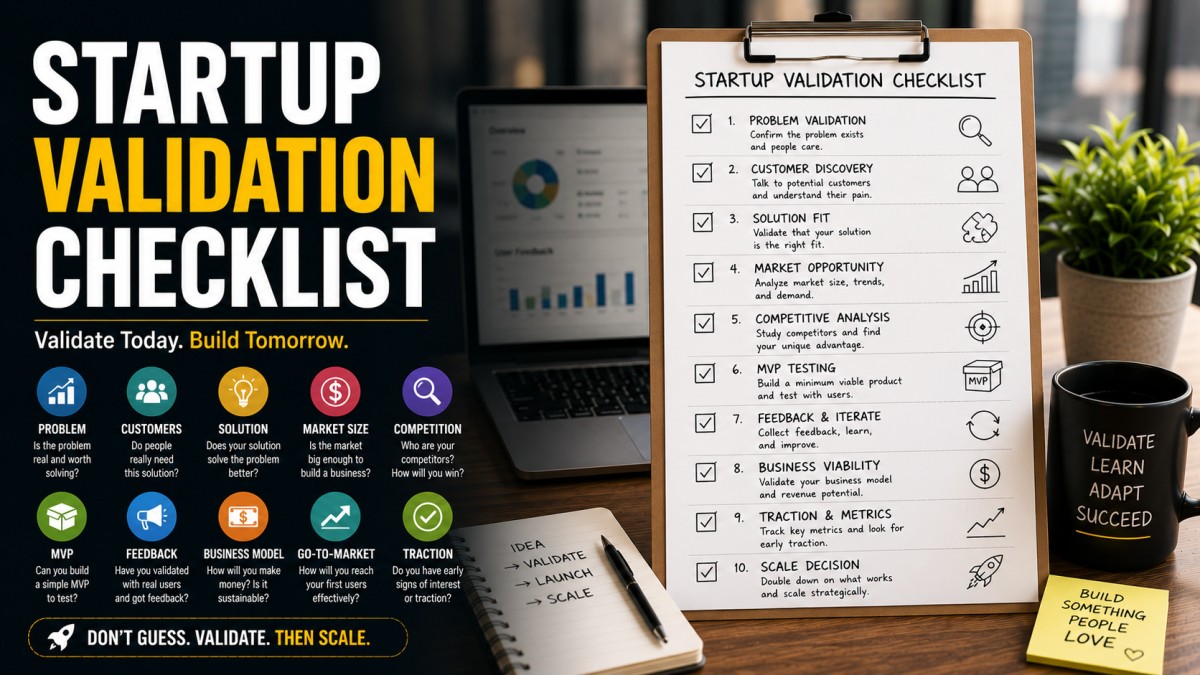
Starting a business is exciting, but one of the biggest reasons startups fail is launching an idea without testing whether people actually want it. Many entrepreneurs invest months of time and thousands of dollars into products that never gain customers. That’s why a startup validation checklist has become an essential resource for founders in 2026.
Following a startup validation checklist helps entrepreneurs reduce risk before investing heavily in development or marketing. Instead of relying on assumptions, startup validation focuses on gathering real customer feedback, testing demand, and confirming that a business idea solves a genuine problem. Whether you’re building a SaaS platform, eCommerce store, mobile app, or digital service, validating your idea first can save both time and money.
The good news is that startup validation doesn’t require a huge budget. Many validation techniques are simple, affordable, and highly effective.
Startup Validation Checklist: Why Validation Is the First Step to Success
Understanding a startup validation checklist begins with one important fact: having a great idea is not enough. A successful startup solves a real problem that customers are willing to pay to fix.
The growing interest in startup validation checklist comes from entrepreneurs realizing that customer research is more valuable than guesswork. By validating an idea early, founders can improve products, adjust pricing, and avoid expensive mistakes before launch.
A validated business idea has a much stronger chance of succeeding in a competitive market.
Identify a Real Problem
Every successful startup begins with a problem worth solving.
Ask yourself:
- What challenge does my product solve?
- Who experiences this problem?
- How often does it occur?
- Are people already searching for a solution?
Clear problems create stronger business opportunities.
Define Your Target Audience
Avoid trying to serve everyone.
Instead, identify:
- Age group.
- Profession.
- Interests.
- Income level.
- Pain points.
A focused audience makes marketing much easier.
Research Your Competitors
Study businesses already serving your market.
Analyze:
- Pricing.
- Features.
- Customer reviews.
- Strengths.
- Weaknesses.
Competitor research helps identify market gaps.
Validate Through Customer Interviews
One of the most valuable steps in a startup validation checklist is talking directly with potential customers.
Ask questions such as:
- What problems do you face?
- How do you currently solve them?
- What would you improve?
- Would you pay for a better solution?
Real conversations provide valuable insights.
Build a Simple Landing Page
Before creating a complete product, test interest.
Include:
- Product description.
- Key benefits.
- Email signup form.
- Call-to-action button.
Landing pages measure market demand effectively.
Test Market Demand
Run small validation campaigns.
Examples include:
- Social media ads.
- Google Ads.
- Email signups.
- Waiting lists.
Early demand helps confirm business potential.
Create a Minimum Viable Product (MVP)
Avoid building every feature immediately.
Launch a basic version that includes only essential functionality.
An MVP allows you to:
- Collect feedback.
- Improve faster.
- Reduce development costs.
Many successful startups began with simple products.
Analyze Customer Feedback
Customer opinions reveal valuable improvement opportunities.
Look for:
- Common complaints.
- Frequently requested features.
- Positive feedback.
- Buying objections.
Continuous improvement increases product-market fit.
Common Startup Validation Mistakes
Many entrepreneurs fail because they:
- Skip customer research.
- Build products too early.
- Ignore feedback.
- Assume demand exists.
- Spend too much before validation.
Testing first reduces unnecessary risks.
Best Practices for Startup Validation
Successful founders usually:
- Focus on solving one problem.
- Talk with real customers.
- Launch an MVP.
- Test demand early.
- Improve based on feedback.
- Track customer behavior.
- Validate pricing.
- Stay flexible.
Data-driven decisions produce better results.
Benefits of Validating a Startup Idea
Using a proper validation process offers several advantages.
These include:
- Lower business risk.
- Better customer understanding.
- Reduced development costs.
- Faster product improvement.
- Higher launch confidence.
Validation creates a stronger business foundation.
Future of Startup Validation
Startup validation continues evolving through:
- AI-powered market research.
- Customer analytics.
- Predictive insights.
- No-code MVP development.
- Automated user feedback tools.
Modern technology allows entrepreneurs to validate ideas faster than ever before.
Conclusion
A well-planned startup validation checklist helps entrepreneurs avoid one of the biggest startup mistakes—building something nobody wants.
By identifying real customer problems, researching competitors, testing demand, launching an MVP, and listening to customer feedback, founders can improve their chances of long-term success. Validation is not about proving your idea is perfect; it’s about making smart decisions before investing significant time and money.
For entrepreneurs launching businesses in the USA, startup validation remains one of the smartest investments before entering the market.
FAQs
1. What is a startup validation checklist?
It is a structured process used to test whether a business idea has real market demand.
2. Why is startup validation important?
It reduces risk and helps entrepreneurs build products customers actually want.
3. What is an MVP?
A Minimum Viable Product is a basic version of a product used to collect customer feedback.
4. How can I validate a startup idea?
Use customer interviews, landing pages, surveys, and small marketing campaigns.
5. Should I build a full product before validation?
No. Validate demand before investing heavily in development.

Consultative Selling Techniques: A Complete Guide to Building Customer Trust in 2026

Sales Objection Handling: A Complete Guide to Closing More Deals in 2026

Customer Closing Techniques: A Complete Guide to Converting Prospects into Buyers (2026)

Customer Conversion Process: A Complete Guide to Turning Visitors into Loyal Customers (2026)

Sales Funnel Examples: A Complete Guide to Converting More Customers (2026)

Lead Qualification Framework: A Complete Guide to Finding High-Quality Customers (2026)

Website Credibility Factors: A Complete Guide to Building Trust Online (2026)

Online Reputation Monitoring: A Complete Guide to Protecting Your Brand in 2026

Customer Testimonial Strategy: A Complete Guide to Building Trust and Increasing Sales (2026)

Business Storytelling Framework: A Complete Guide to Building Strong Brand Connections (2026)
Consultative Selling Techniques: A Complete Guide to Building Customer Trust in 2026
Sales Objection Handling: A Complete Guide to Closing More Deals in 2026
Customer Closing Techniques: A Complete Guide to Converting Prospects into Buyers (2026)
Customer Conversion Process: A Complete Guide to Turning Visitors into Loyal Customers (2026)
Sales Funnel Examples: A Complete Guide to Converting More Customers (2026)
Lead Qualification Framework: A Complete Guide to Finding High-Quality Customers (2026)
Website Credibility Factors: A Complete Guide to Building Trust Online (2026)
Online Reputation Monitoring: A Complete Guide to Protecting Your Brand in 2026
Customer Testimonial Strategy: A Complete Guide to Building Trust and Increasing Sales (2026)
Business Storytelling Framework: A Complete Guide to Building Strong Brand Connections (2026)

 entertainment1 year ago
PYT Telegram: A Complete Guide to Understanding, Using, and Maximizing It

 entertainment1 year ago
OnionFlix: Everything You Need to Know About This Streaming Website
- education1 year ago
How to Become a Software Engineer: A Complete Guide
- others1 year ago
Nook vs Kindle: Which E-Reader Is Right for You?