tech
Pixel Value Differencing: A Smart Approach to Image Steganography

Introduction to Pixel Value Differencing (PVD)
Pixel Value Differencing. In the digital age, information security plays a vital role in communication and data transfer. One innovative technique in the field of image steganography is Pixel Value Differencing (PVD) a method used to hide secret data within digital images while maintaining the visual quality of the cover image. This technique ensures that hidden information remains imperceptible to the human eye.
Understanding Image Steganography
Steganography is the practice of concealing information within other non-secret data, such as images, videos, or text. Unlike cryptography, which scrambles data to make it unreadable, steganography hides the very existence of the message.
Image steganography uses digital images as carriers (cover images) to embed hidden information. Among various techniques like Least Significant Bit (LSB) and Transform Domain Methods, Pixel Value Differencing stands out for its balance between data capacity and imperceptibility.
How Pixel Value Differencing Works
Concept of Pixel Pairs
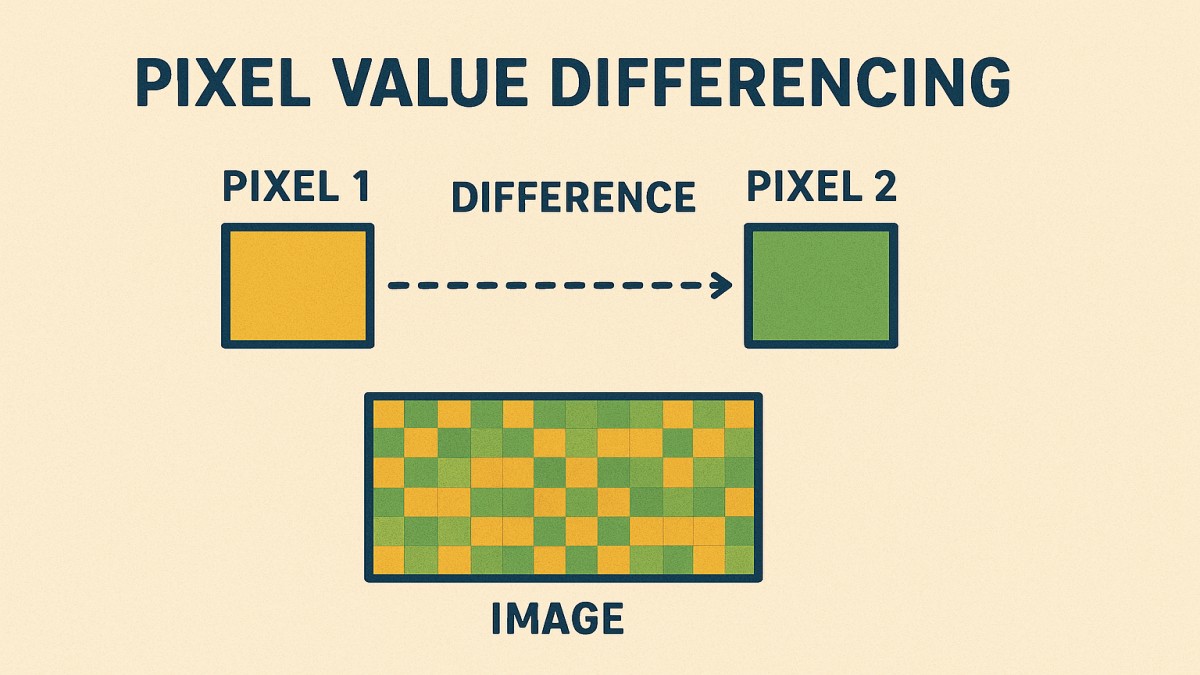
The PVD method works by dividing an image into non-overlapping pairs of consecutive pixels. Each pair of pixel carries a small piece of hidden information based on the difference in their intensity values.
Calculating Pixel Differences
Let’s say two consecutive pixels in an image are represented as P1 and P2.
The difference value (d) is calculated as: d=∣P2−P1∣d = |P2 – P1|d=∣P2−P1∣
This difference indicates how smooth or edge-like a region is.
- Small difference values → smooth regions (less noticeable changes).
- Large difference values → edges or textures (can hide more data).
Data Embedding Process
- Divide the image into pixel pairs.
- Compute the difference
dfor each pair. - Determine a range in which
dfalls (e.g., 0–7, 8–15, etc.). - Depending on this range, decide how many bits of secret data can be embedded.
- Modify the pixel values slightly to encode the data while maintaining the difference within that range.
This process ensures that the visual quality of the image remains unaffected.
Mathematical Model of PVD
Let’s define a range table:
| Range (R) | Lower Bound (L) | Upper Bound (U) | Number of Bits (n) |
|---|---|---|---|
| R1 | 0 | 7 | 3 |
| R2 | 8 | 15 | 4 |
| R3 | 16 | 31 | 5 |
| R4 | 32 | 63 | 6 |
Here, n = log2(U - L + 1) gives the number of bits that can be hidden in that range.
After embedding, the new pixel difference d' is adjusted to ensure that: L≤d′≤UL \leq d’ \leq UL≤d′≤U
The modified pixel values (P1' and P2') are recalculated to preserve the mean brightness and maintain visual consistency.
Example of PVD Encoding and Decoding
Suppose we have two pixels with values P1 = 100 and P2 = 105.
Difference d = |105 - 100| = 5.
This difference lies in the range 0–7, allowing 3 bits of secret data to be hidden.
If the secret bits are 101 (decimal 5), we modify the pixel pair so that the new difference d' = L + secret_value = 0 + 5 = 5.
Then, we slightly adjust P1 and P2 to achieve this new difference.
During decoding, the process is reversed:
- Compute the difference
d'. - Identify the range.
- Extract the embedded bits from the difference value.
Advantages of Using PVD
- High Embedding Capacity: PVD adapts to pixel intensity differences, allowing more data to be hidden in edge regions.
- Good Image Quality: Changes are visually imperceptible.
- Simple Implementation: Easy to integrate with other steganographic techniques.
- Scalability: Works efficiently on both grayscale and color images.
Limitations of PVD Techniques
- Vulnerability to Image Processing: Operations like compression, cropping, or filtering may distort hidden data.
- Limited Robustness: Compared to transform-domain methods (like DCT or DWT), PVD is more fragile.
- Detection Risks: Statistical analysis can sometimes reveal abnormal pixel difference patterns.
PVD in Grayscale vs. Color Images
While traditional PVD is applied to grayscale images, modern research extends it to color images. Each RGB channel can embed data independently, significantly increasing capacity. However, careful balancing is needed to prevent color distortion.
Conclusion
Pixel Value Differencing (PVD) represents a clever balance between data security and image quality. By exploiting pixel intensity variations, it allows high-capacity data hiding without noticeable distortion. While it has certain limitations, ongoing advancements—like adaptive algorithms and AI integration—are paving the way for PVD to remain a cornerstone of modern steganography and cybersecurity.
FAQs
1. What is the main purpose of Pixel Value Differencing?
To hide secret data in images by modifying pixel intensity differences while maintaining image quality.
2. How is PVD different from LSB steganography?
PVD adjusts data capacity dynamically based on pixel differences, whereas LSB modifies the least significant bits directly.
3. Can PVD be used in color images?
Yes, PVD can be applied to RGB channels independently to increase data capacity.
4. What is the biggest limitation of PVD?
It is sensitive to image compression and may be detected through statistical analysis.
5. What is the future of PVD technology?
Integration with AI, encryption, and blockchain will make PVD more secure and adaptable for advanced cybersecurity applications.

Consultative Selling Techniques: A Complete Guide to Building Customer Trust in 2026

Sales Objection Handling: A Complete Guide to Closing More Deals in 2026

Customer Closing Techniques: A Complete Guide to Converting Prospects into Buyers (2026)

Customer Conversion Process: A Complete Guide to Turning Visitors into Loyal Customers (2026)

Sales Funnel Examples: A Complete Guide to Converting More Customers (2026)

Lead Qualification Framework: A Complete Guide to Finding High-Quality Customers (2026)

Website Credibility Factors: A Complete Guide to Building Trust Online (2026)

Online Reputation Monitoring: A Complete Guide to Protecting Your Brand in 2026

Customer Testimonial Strategy: A Complete Guide to Building Trust and Increasing Sales (2026)

Business Storytelling Framework: A Complete Guide to Building Strong Brand Connections (2026)
Consultative Selling Techniques: A Complete Guide to Building Customer Trust in 2026
Sales Objection Handling: A Complete Guide to Closing More Deals in 2026
Customer Closing Techniques: A Complete Guide to Converting Prospects into Buyers (2026)
Customer Conversion Process: A Complete Guide to Turning Visitors into Loyal Customers (2026)
Sales Funnel Examples: A Complete Guide to Converting More Customers (2026)
Lead Qualification Framework: A Complete Guide to Finding High-Quality Customers (2026)
Website Credibility Factors: A Complete Guide to Building Trust Online (2026)
Online Reputation Monitoring: A Complete Guide to Protecting Your Brand in 2026
Customer Testimonial Strategy: A Complete Guide to Building Trust and Increasing Sales (2026)
Business Storytelling Framework: A Complete Guide to Building Strong Brand Connections (2026)

 entertainment1 year ago
PYT Telegram: A Complete Guide to Understanding, Using, and Maximizing It

 entertainment1 year ago
OnionFlix: Everything You Need to Know About This Streaming Website
- education1 year ago
How to Become a Software Engineer: A Complete Guide
- others12 months ago
Nook vs Kindle: Which E-Reader Is Right for You?