
business
Cool Air, Warm Profits: How to Start an HVAC Business

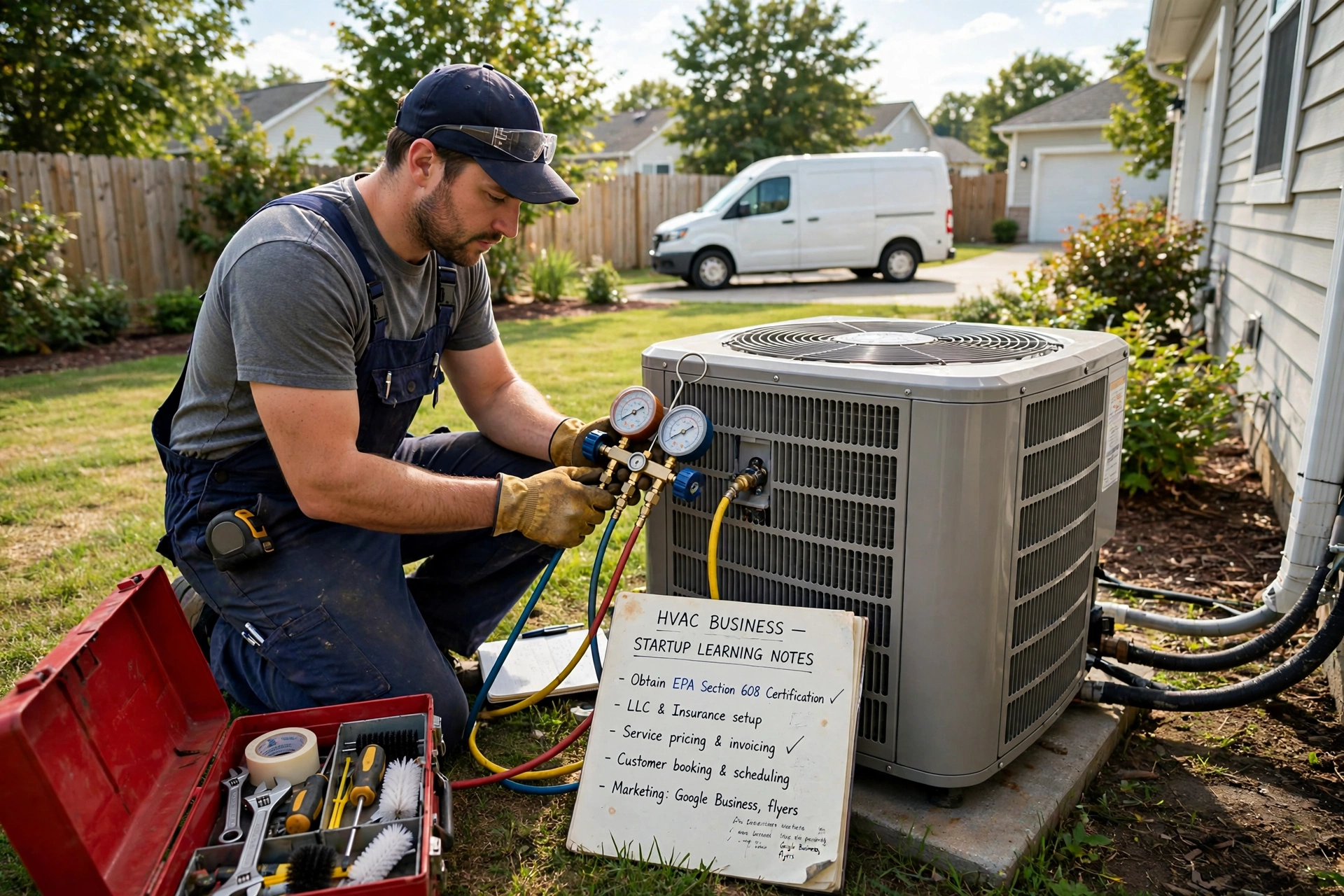
Every home and office needs heating in winter and cooling in summer, and when the system breaks down, nobody waits. That is why learning how to start an HVAC business is one of the smartest moves a skilled technician can make. The work is steady all year, customers pay quickly, and a good reputation brings repeat jobs for decades.
This guide walks through each step in the order that works, from getting certified and licensed to pricing jobs and winning your first customers. The steps below work whether you are figuring out how to start an HVAC business on your own or planning how to start an HVAC company with a partner. If you already know the trade, the business side is the part to learn now.
Why an HVAC Business Is Worth Starting
Heating, ventilation and air conditioning is not a trend. Every building has a system, every system needs servicing, and every system eventually needs replacing. Summer brings air conditioning breakdowns, winter brings heating failures, and spring and autumn bring maintenance work. That gives you four seasons of demand instead of one.
The barrier to entry also works in your favour. Customers cannot do this work themselves, and they cannot hire just anyone: the law requires certified technicians for refrigerant work. That keeps unqualified competition out and keeps prices healthy for people who do the job properly. Better still, heating and cooling systems wear out on a schedule. A furnace or air conditioner fitted today will need servicing every year and replacing in ten to fifteen years, which means every installation you complete today becomes service work for the next decade. Few trades give you that kind of built-in future income.
Step 1: Get Experience and EPA Section 608 Certification
Before anything else, you need the credentials. In the United States, anyone who handles refrigerants must hold EPA Section 608 certification. It is a federal requirement under the Clean Air Act, and there are no exceptions. Without it you cannot legally buy refrigerant or open a refrigerant circuit, which means you cannot service most air conditioning systems.
There are four types of Section 608 certification. Type I covers small appliances, Type II covers high-pressure systems, Type III covers low-pressure systems, and Universal covers all of them. Get the Universal card. The exam costs around $20 to $40, takes a few days of study, and covers you for anything you will meet on the job.
Experience matters just as much as the card. Most states want two to five years of documented field experience before they will issue a contractor licence, and customers want a technician who has seen real faults, not just textbook ones. If you have not got the years yet, work for an established company first. Learn how jobs are priced, how customers are handled, and how a van is stocked. That paid education is worth more than any course.
Step 2: Decide What Kind of HVAC Business You Are Building
Not every HVAC company does the same work, and trying to do everything at once is a common mistake. Pick a clear starting focus:
- Residential service and repair: fixing home heating and cooling systems, replacing parts, and responding to breakdowns. Fast jobs, quick payment, and lots of repeat customers.
- Residential installation: fitting new air conditioning units, furnaces and heat pumps in homes. Bigger tickets, more planning, and strong word of mouth.
- Commercial HVAC services: maintaining and repairing heating and cooling systems in offices, shops, restaurants and small industrial buildings. Larger contracts, scheduled work, and steadier income once you are in.
- Maintenance plans: regular servicing visits sold as annual agreements. This is the steadiest income in the trade and the best way to smooth out quiet months.
Most new owners start with residential service and repair, add installation work as they grow, and take on commercial HVAC services once they have a team. Whatever you choose, write it down. A business that tries to serve everyone ends up serving no one well.
Step 3: Write Your HVAC Business Plan
A solid HVAC business plan does not need to be fifty pages. One or two pages that answer the right questions will do more good than a thick document nobody reads. Cover these points:
- Services: exactly what you will offer in year one, and what you will add later.
- Customers: who they are, where they live, and how you will reach them.
- Competitors: what other local companies charge and what they do badly.
- Prices: your hourly rate or flat rates, and the margin you need on parts.
- Money: your startup budget, your monthly running costs, and how many jobs a month you need to break even.
- Goals: realistic targets for the first six months and the first year.
Your plan also answers the practical questions behind how to start an HVAC company: what you will sell, who will buy it, and what it will cost to deliver. If you ever need a loan, the bank will want to see your HVAC business plan. Even if you never borrow, writing it forces you to think through the numbers before you spend money. Update it every six months as the business grows.
Step 4: Register the Company and Sort Out Licences
Forming the company is straightforward but must be done properly. Most small HVAC owners register a limited liability company, which separates your personal money from the business. File with your state’s Secretary of State, get a free Employer Identification Number from the IRS, and open a business bank account so personal and business money never mix.
Licensing is the step that takes longest, so start it early. The rules vary a lot by state. Some states license HVAC contractors at state level, such as Texas and California, while others leave it to cities and counties. Check the exact requirements with the agency named for your area before you spend money, and confirm whether your state wants a licensed person tied to the business. A few states have no statewide HVAC licence at all, but the local council may still require one.
Do not take paid work until the licence question is settled. Working without the right licence can mean fines, refused insurance claims, and a reputation you cannot repair.
Step 5: Get HVAC Business Insurance
Insurance is not optional in this trade. You work with gas, electricity, refrigerant and other people’s property, and one mistake can cost far more than a year’s profit. At minimum, arrange:
- General liability insurance: covers damage to a customer’s property and injuries on site. Most customers and commercial clients will ask to see proof before they hire you.
- Commercial vehicle insurance: your van is a business vehicle, and a personal policy will not cover it while you are working.
- Workers’ compensation: required in most states once you hire anyone, and sensible even before that.
- Tools and equipment cover: replacing a full set of gauges, pumps and meters after a theft is expensive.
Good HVAC business insurance costs a few hundred dollars a month for a solo operator, and it is one of the best investments you will make. It also makes you look professional: customers trust a company that is properly covered.
Step 6: Work Out How Much Does It Cost to Start an HVAC Business
One of the first questions every new owner asks is how much does it cost to start an HVAC business. The honest answer is that it depends on what you already own. If you already hold the licence and the EPA Section 608 card, own a vehicle, and work solo on service and tune-ups, the bare minimum is roughly $7,000 to $12,000. If you need a van, a full tool kit, stock and marketing from scratch, expect $30,000 to $50,000.
A realistic starting budget looks like this:
- Licences, certification and registration: $500 to $2,000
- Insurance for the first year: $2,000 to $5,000
- Tools and diagnostic equipment: $2,000 to $6,000
- Van or truck (used): $8,000 to $25,000
- Initial parts stock: $1,000 to $3,000
- Website, branding and first marketing: $500 to $2,000
- Working capital (three months of bills): $5,000 to $10,000
Keep a cash reserve. The first months are slow, suppliers want payment before customers pay you, and a van repair at the wrong moment can sink a new business that has no buffer. Knowing how much does it cost to start an HVAC business before you begin is what separates owners who survive year one from those who do not.
Step 7: Equip Your Van and Buy the Right Tools
Your van is your workshop, your warehouse and your advert all in one. Buy the best used van you can afford, keep it clean, and signwrite it with your company name and phone number. Customers notice a tidy van, and it works for you every time you park outside a job.
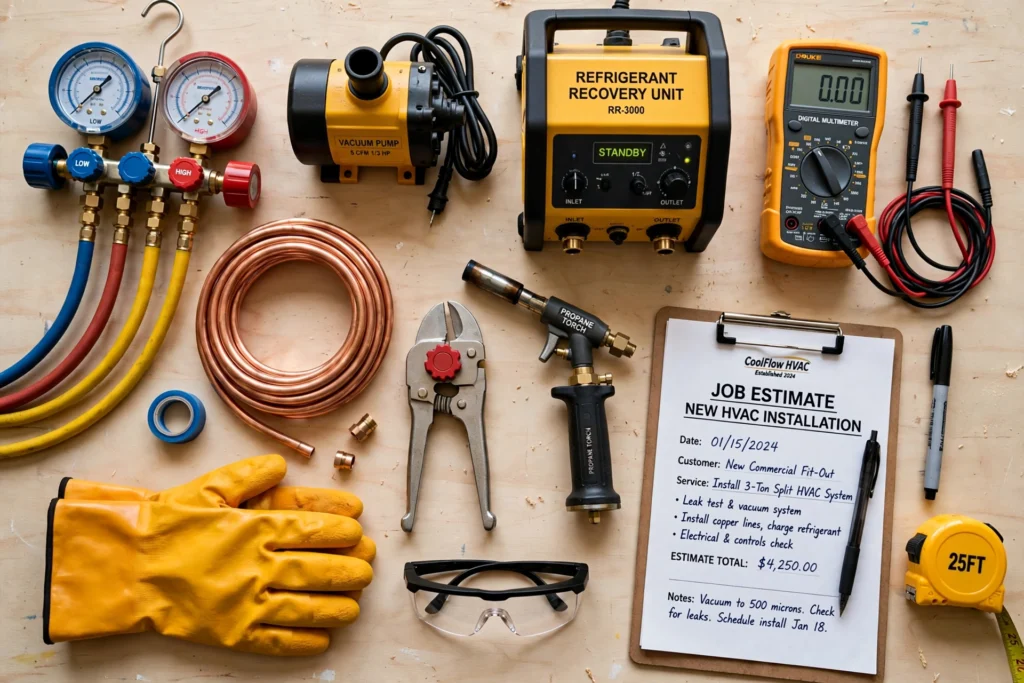
The core tool kit for a new HVAC technician includes a manifold gauge set, a vacuum pump, a refrigerant recovery machine, a digital multimeter, a leak detector, a pipe cutter and brazing torch, a good set of hand tools, and a sturdy ladder. Buy quality on the tools you use every day and save money on the ones you use once a month.
Open accounts with local HVAC suppliers early. Supplier credit, a trade discount and a reliable parts counter will save you hours every week. Stock the common parts — capacitors, contactors, filters, fuses and thermostats — so most repairs finish in a single visit. Customers remember the technician who fixed it today, not the one who had to come back next week.
What to Keep Stocked in Your Van
A well-stocked van is the difference between finishing a job in one visit and losing a day to a second trip. Start with the parts that fail most often: capacitors, contactors, fuses, filters, fan motors, igniters, flame sensors and thermostats. Add refrigerant, copper fittings, brazing rods, electrical connectors and a small stock of pipe and insulation. Keep it organised in labelled bins so you can find anything in the dark, in the rain, at nine o’clock at night.
Restock every Friday without fail. Count what you used during the week, order replacements, and check your gauges and meters are still calibrated. A van that is always ready means you can say yes to emergency calls, and emergency calls are the best-paid work in the trade. They also produce the most grateful customers, and grateful customers leave the best reviews.
Step 8: Choose a Name Customers Remember
Good HVAC company names are short, clear and easy to say on the phone. Customers should hear it once and be able to find you again. Avoid clever spellings, long names and anything that needs explaining.
A few rules that work:
- Include what you do, such as heating, cooling, air or climate.
- Include your town or area if you serve one place.
- Keep it under three words if you can.
- Check the name is free as a domain, on social media, and with your state’s business register before you print anything.
Some of the best HVAC company names are simple combinations: a family name plus “Heating and Cooling”, or a local word plus “Air”. Pick a name you will still be proud of in ten years, then use it everywhere: van, invoices, website and workwear.
Step 9: Price Your Jobs So You Actually Make Money
Pricing is where many new HVAC owners fail. Charge too little and you work hard for nothing; charge too much and the phone stops ringing. Learning how to price HVAC jobs properly is a skill, and it starts with knowing your costs.
Work out your cost per billable hour first: add up your monthly overheads, your salary, van costs, insurance and tool replacement, then divide by the hours you can actually bill. That number is your floor. Every job must cover it, plus a margin for profit and a buffer for callbacks.
For common work, flat-rate pricing beats hourly pricing. Customers prefer knowing the price before you start, and flat rates reward you for working efficiently. A capacitor replacement, a system tune-up or a thermostat swap can all have fixed prices that customers accept without argument. For bigger work, such as a full system replacement, give a written quote that lists equipment, labour and warranty separately.
Always put prices in writing before you start, and never apologise for charging fairly. Knowing how to price HVAC jobs with confidence is what turns a busy technician into a profitable business owner. Review your prices every year: if your costs rise and your prices do not, your profit quietly disappears.
Step 10: Win Your First Customers
A new HVAC business lives or dies on its first twenty customers, so learning how to get HVAC customers is the most important marketing skill you will build. If you are wondering how to get HVAC customers without spending a fortune on adverts, start local and start free — the channels below cost little and bring the best kind of work, the kind that comes from a neighbour’s recommendation. Start with the free and local channels first:
- Google Business Profile: claim it, fill it in completely, add photos of real work, and ask every happy customer for a review. This is the single best source of new calls for a local trade.
- Your existing network: tell friends, family, neighbours and past colleagues that you are open for work. A personal recommendation beats any advert.
- Local partnerships: estate agents, property managers, landlords and builders all need a reliable HVAC technician. One good partnership can fill your diary.
- Flyers and door drops: simple, honest flyers in the streets you want to work in still bring calls, especially before summer and winter.
- A fast mobile website: customers search on their phones and call the company whose number they can find in seconds. Show your licence, your services and your phone number on the first screen.
Once the phone starts ringing, sell HVAC maintenance contracts to every customer you serve. A maintenance contract gives the customer two servicing visits a year and priority booking, and it gives you guaranteed income in the quiet months. Customers on a contract call you first when something breaks, and they recommend you to neighbours. Over time, a book of HVAC maintenance contracts becomes the most valuable asset in your business.
Commercial work follows the same logic at a bigger scale. Offer offices and shops a scheduled maintenance agreement, turn up on time, send clear reports, and you will keep that contract for years. That is how small HVAC companies grow into steady, profitable businesses.
Mistakes New HVAC Owners Make
- Skipping the licence and certification step. It feels slow, but working without them risks fines and kills your insurance cover.
- Underpricing to win work. Cheap prices attract the worst customers and leave no money for growth.
- No cash reserve. A quiet month or a van repair should be an inconvenience, not a crisis.
- Ignoring maintenance contracts. One-off jobs pay once; HVAC maintenance contracts pay every year.
- Doing all the paperwork at midnight. Use simple field service software from day one. Invoicing, scheduling and customer records are far easier to manage early than to fix later.
- No follow-up. A short message after each job asking for a review brings more work than any advert.
Frequently Asked Questions
Do I need a licence to start an HVAC business?
In most places, yes. The exact requirement depends on your state, city or county: some states license HVAC contractors directly, while others leave it to local authorities. On top of that, EPA Section 608 certification is a federal requirement for anyone who handles refrigerants. Check the rules for your area before taking paid work.
How much money do I need to start an HVAC business?
If you already have the licence, the EPA Section 608 card and a vehicle, you can start with roughly $7,000 to $12,000. Starting from scratch with a van, tools, stock and marketing usually needs $30,000 to $50,000. Keep a cash reserve for the first slow months.
What services should a new HVAC business offer first?
Start with residential service and repair, which brings fast jobs and quick payment. Add installation work as you grow, then take on commercial HVAC services and maintenance agreements once you have a team and a reputation.
How do I price HVAC jobs fairly?
Work out your true cost per billable hour, including overheads, salary, van and insurance, then build flat rates for common jobs from that number. Put every price in writing before you start, and review your rates at least once a year.
How can a new HVAC business get customers?
Claim your Google Business Profile and ask every happy customer for a review, tell your network you are open, partner with estate agents and property managers, and offer HVAC maintenance contracts to every customer you serve. Repeat customers and referrals are the cheapest marketing in the trade.
Final Word
Learning how to start an HVAC business is mostly about doing the unglamorous steps in the right order: get certified, get licensed, write a simple plan, insure yourself properly, equip the van, price fairly and look after every customer. The trade itself you already know. The business is a second skill, and it is one you can learn the same way: one job at a time, with honest work and clear prices. The marketing never stops either: knowing how to get HVAC customers is a skill you will keep using long after the first year, because every quiet week is a reminder to ask for reviews, call past customers about servicing, and stay visible in your area. Start small, keep your costs under control, build a book of maintenance customers, and the business will grow with you.

Sparks to Success: How to Start an Electrical Business

Cool Air, Warm Profits: How to Start an HVAC Business

Wrenches to Wealth: How to Start a Plumbing Business

Shingles to Success: How to Start a Roofing Business

Posts, Panels and Profit: How to Start a Fencing Business

First Cut, Full Crew: How to Start a Tree Trimming Business

Ladder to Lights: How to Start a Christmas Light Business

Clear Water, Steady Pay: Starting a Pool Cleaning Business

Green Thumb to Paycheck: Starting a Landscaping Business

Turn Winter Into Income: How to Start a Snow Removal Business

How to Repurpose Blog Content for Social Media Without Starting From Scratch

How to Write a Simple Business Plan for Your Small Business: A Practical Guide That Gets You Started

How to Get More Clients for Your Business: Simple Ways That Actually Work

How to Create a Small Business Content Marketing Plan That Actually Gets Results

How to Write a Professional Business Email That Gets a Reply

Branding Tips for Small Businesses: A Simple Guide That Makes You Memorable
How to Create a Content Calendar for a Small Business
How to Handle Customer Complaints in a Small Business: A Calm, Practical Guide That Turns Problems Into Loyalty
How to Set Up a Simple Referral Program for Your Small Business: A Beginner’s Guide That Brings in New Customers

How to Set SMART Goals for a Small Business: A Practical Guide That Actually Works
Sparks to Success: How to Start an Electrical Business
Cool Air, Warm Profits: How to Start an HVAC Business
Wrenches to Wealth: How to Start a Plumbing Business
Shingles to Success: How to Start a Roofing Business
Posts, Panels and Profit: How to Start a Fencing Business
First Cut, Full Crew: How to Start a Tree Trimming Business
Ladder to Lights: How to Start a Christmas Light Business
Clear Water, Steady Pay: Starting a Pool Cleaning Business
Green Thumb to Paycheck: Starting a Landscaping Business
Turn Winter Into Income: How to Start a Snow Removal Business

 entertainment1 year ago
PYT Telegram: A Complete Guide to Understanding, Using, and Maximizing It

 entertainment1 year ago
OnionFlix: Everything You Need to Know About This Streaming Website
- education1 year ago
How to Become a Software Engineer: A Complete Guide
- entertainment10 months ago
Brainrot Memes: The Unhinged Humor of the Internet Generation





