
business
Sparks to Success: How to Start an Electrical Business

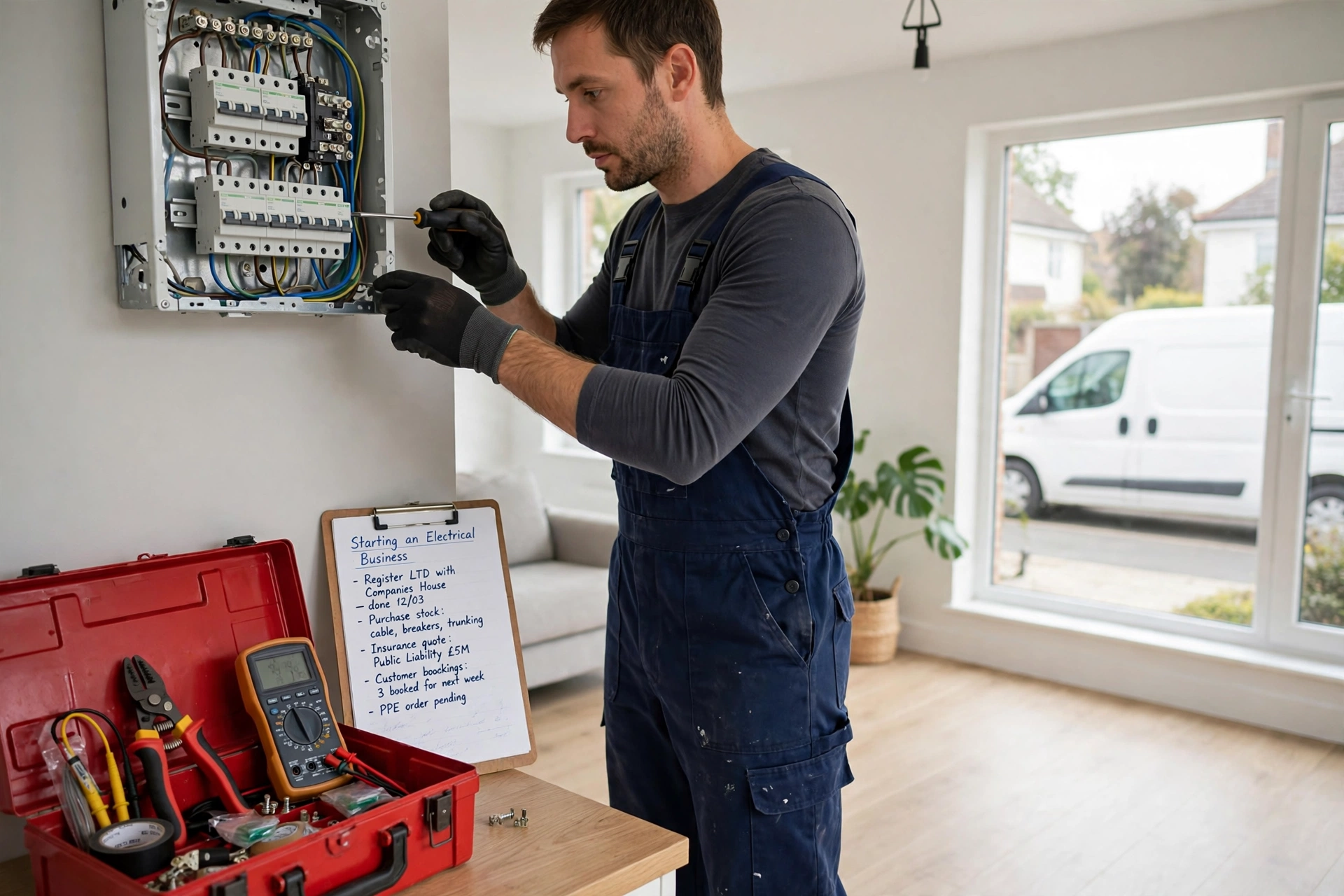
Introduction
If you can wire a house, fault-find a dead circuit and read a wiring diagram without breaking a sweat, you already have the hardest part of running an electrical firm. The trade is the easy bit. The business around it — licences, insurance, pricing, customers — is where most new firms stumble. This guide explains how to start an electrical business step by step, from the licence that lets you trade legally to the day you book your first paying job.
The timing is good. Homes keep adding EV chargers, heat pumps, solar panels and smart controls, and every one of those jobs needs a qualified electrician. Commercial clients need maintenance contracts, testing and upgrades too. A small, well-run electrical company can grow steadily on repeat work and referrals, and the work cannot be outsourced overseas. Follow the ten steps below and you will launch with a solid foundation instead of learning expensive lessons on the job. The steps work whether you are launching as a sole trader or a limited company, and they cover how to start an electrician business from licence to first invoice.
Step 1: Decide What Services You Will Offer
Before you register anything, decide what kind of electrical work your new firm will actually sell. Trying to do everything from day one spreads you thin and confuses customers. Pick a lane, get good at it, then widen it.
Residential electrical services are the natural starting point for most new firms. Homeowners need consumer unit upgrades, rewires, new circuits, socket and lighting installs, outdoor power, EV charger fitting and fault-finding. These jobs are quick to quote, quick to complete and quick to get paid for, and happy homeowners refer their neighbours. Residential work also builds the reviews and word of mouth a new business needs.
Commercial electrical services pay more per job but come with longer sales cycles, formal quotes, purchase orders and payment terms of 30 days or more. Offices, shops, restaurants and warehouses need lighting design, three-phase installs, data cabling, emergency lighting and periodic inspection and testing. If you have commercial experience from your employed years, this can be a strong second lane once the residential side is running.
A sensible launch mix is 80 percent residential and 20 percent commercial in year one, then rebalance as your contacts grow. Write your service list down before you move to Step 2, because it shapes your licence, your insurance and your pricing.
Step 2: Get Licensed and Meet Your State’s Requirements
Licensing is the gate for this trade, and it is the step that separates electrical work from most other service businesses. In most places you cannot legally contract electrical work, pull a permit or sign off an installation without the right credentials, and your customers’ insurers will ask to see them.
The usual path runs apprentice, then journeyman, then master electrician. An apprenticeship typically takes four to five years and combines paid on-the-job training with classroom study of wiring regulations, theory and safety. After your hours and a passing exam you become a licensed journeyman who can work on your own, subject to local rules. A master electrician qualification is the next level, and it is often the credential that lets a business owner act as the qualifying party for the firm.
Here is the part many new owners miss: your personal licence and the firm’s licence are usually two different things. A journeyman or master licence authorises the individual to do electrical work. Running a company almost always requires a separate electrical contractor licence, held by the business and tied to a named qualifying person, usually a master electrician. That contractor licence is what lets the firm bid jobs, hire licensed electricians and pull permits.
Rules vary a lot by state and city, so check your state licensing board and your municipality before you spend money on anything else. Some states issue a statewide contractor licence; others leave it to counties or cities. A few require a licence bond as well. Budget for exam fees, application fees and any continuing education your licence requires, and keep copies of every certificate — clients, general contractors and insurers will all ask for them.
Step 3: Write a Simple Electrical Business Plan
An electrical business plan does not need to be a 40-page document. It needs to answer five questions on one or two pages: who are your customers, what services will you sell them, what will you charge, what will it cost you to run, and how will customers find you.
Start with your market. List the towns or neighbourhoods you will serve, the type of customer in each (homeowners, landlords, letting agents, small builders, offices) and the three services you will lead with. Then set your first-year revenue target. A solo electrician billing 30 hours a week at a realistic rate can turn over a solid income in year one, but only if those hours are actually booked — so be honest about how many weeks you will spend building a pipeline.
Next, list your costs: van, tools, insurance, licence fees, phone, software, fuel, materials and a marketing budget. Then work out your break-even point — the monthly revenue that covers all of it. Knowing that number stops you from accepting work at a loss just to stay busy.
Finally, write down how you will win work: Google Business Profile, local directories, letting agents, builders, referrals and a simple website. A plan you can read in five minutes beats a plan that sits in a drawer. Anyone figuring out how to start an electrical company should write this plan before spending money on tools or a van. Revisit it every quarter and update the numbers with what actually happened.
Step 4: Register the Business and Choose a Name
With your licence path clear and a plan in hand, make the business official. This is the point where learning how to start an electrical company turns into paperwork, so take it one form at a time. Most electricians start as a sole trader or a limited company. A sole trader setup is quick and cheap, but your personal assets are on the line if something goes wrong. A limited company costs a little more to set up and run, yet it separates your business debts and claims from your personal finances, and many commercial clients prefer dealing with a limited company. Talk to an accountant before you choose — the tax difference alone can be worth the fee.
Register your business name, get your tax number, and open a business bank account so business money never mixes with personal money. If you trade under a name that is not your own, check that it is available and register it properly.
Choosing from electrical company names is worth more thought than most people give it. Once you have shortlisted three electrical company names, test each one by saying it out loud as if you were answering the phone. The best names are short, easy to spell over the phone, and clearly electrical. “Amped Up Electrical”, “Bright Spark Electrical” and “Current Electrical Services” all tell a customer what you do in three words. Avoid names that are hard to pronounce, hard to spell, or so generic that customers cannot find you online. Check the name on your state register, as a domain name, and on social media before you commit to it — and make sure it does not clash with an existing firm in your area.
Step 5: Get the Right Insurance
Insurance is not optional in this trade. One faulty connection can cause a fire, and one accident on site can lead to a claim that would wipe out a new business. The right cover protects you, your customers and your family.
Start with general liability insurance. It covers property damage and injury to third parties — for example, if your work damages a customer’s home or a visitor trips over your cable. Most domestic customers will not ask to see it, but letting agents, builders and commercial clients will ask for your certificate before you start, so have it ready.
Add commercial vehicle insurance for your van, because a personal policy will not cover business use. If you hire anyone, even part time, you will need workers’ compensation cover. An electrical business insurance package often bundles liability, tools cover and public liability together, and it is usually cheaper than buying each policy separately. Get three quotes, check the excess on each, and read what is excluded — cheap cover that excludes the work you actually do is worthless.
Keep your certificates in a folder you can reach from your phone. When a client asks, send it within minutes. It is a small detail that makes you look professional and wins work. Review your electrical business insurance every year as the firm grows — a policy that fitted a solo van may not cover two vans and an apprentice.
Step 6: Buy Tools, Equipment and a Van
You probably own most of your hand tools already, but a business needs more than a toolbox. This is the step where the in-article photo below comes in handy as a checklist — every item in it earns its keep in the first month.
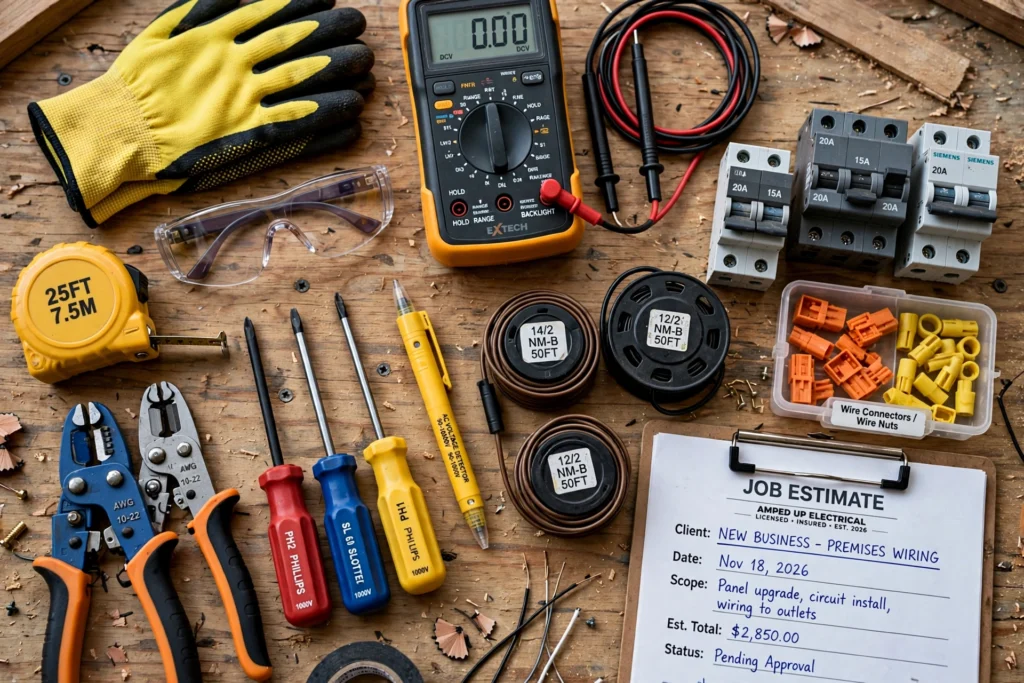
Your core kit should include a quality digital multimeter, a voltage tester, insulated screwdrivers and pliers, wire strippers, a cable tracer, a torque screwdriver, a drill and impact driver, a head torch, a step ladder and a lock-off kit for safe isolation. Add a multifunction tester if you plan to do inspection and testing work, because you cannot certify an installation without one. Buy once and buy well: cheap test gear that gives unreliable readings will cost you far more in callbacks than it saves at the till.
Your van is your workshop on wheels. A medium panel van with racking, a roof rack for ladders and conduit, and a secure lockbox for copper and tools is the standard setup. Signwrite it with your business name, phone number and website — a clean, branded van parked outside a job is free advertising in every street you work in. Keep it stocked with the parts you use every week: cable, breakers, sockets, switches, connectors and fixings, so you are not losing billable hours to the wholesaler on every job.
Step 7: Work Out Your Start-Up Costs
New owners always ask what it costs to get started, and the honest answer is that it depends on what you already own and how big you go on day one. A lean launch — you hold the licence, own a van and hand tools, and work solo on service calls and small jobs — can be done for roughly $8,000 to $15,000. A fully equipped professional setup with a leased van, premium cordless tools, a multifunction tester, vehicle racking and branding typically runs $15,000 to $30,000.
The big items are the van, the test equipment, insurance and your licence and registration fees. The small items add up too: workwear, van stock, a phone plan, invoicing software and your first marketing spend. Write every item down with a price, then add 20 percent as a buffer for the costs you forgot. That buffer is what keeps a flat tyre or a broken drill from becoming a cash crisis in month one.
Do not borrow more than you need. A modest start with low monthly costs gives you room to learn, price properly and build a customer base. You can upgrade the van and the kit once the work is paying for them.
Step 8: Price Your Jobs So You Actually Make Money
Pricing is where new electrical firms fail most often. Charge too little and you work long hours for nothing; charge too much and the phone stops ringing. The fix is to price from your costs, not from what the firm down the road charges.
First, work out your true hourly cost. Add up your monthly business costs — van, fuel, insurance, phone, software, licence fees, tools and your own wage — then divide by the hours you can actually bill. Most electricians bill 25 to 35 hours a week once travel, quoting, admin and no-shows are counted. That hourly figure is your floor. Your charge-out rate must sit above it, with room for profit and tax.
Learning how to price electrical jobs properly means using flat rates for common work and hourly rates for fault-finding. A consumer unit change, an EV charger install or a socket addition can be flat-rated once you know your average time and materials. Fault-finding is better billed hourly, because you cannot know how long a hidden fault will take until you find it. Always quote in writing, state what is included and what is not, and take a deposit on larger jobs to cover materials.
Review your rates every six months. The fastest way to learn how to price electrical jobs is to track every job for a month — time on site, materials, travel — and compare the real cost against what you charged. If you are booked out three weeks ahead, your prices are too low. If quotes go unanswered, check whether your quotes are slow or unclear before you cut your rate — most lost jobs are lost on speed and presentation, not price.
Step 9: Set Up Software and Systems
A one-person firm can run on a notebook and a phone for a month. After that, the admin starts eating your evenings. Set up simple systems early, while you still have time to learn them.
Good electrical business software handles quoting, scheduling, invoicing, customer records and payment reminders in one place. The best electrical business software for a small firm is the one you will actually use every day, so trial two or three options before you pay for one. When a customer calls, you should be able to see their address, their job history and any unpaid invoice in seconds. The software should also store photos of completed work, certificates and test results against each job, so nothing gets lost.
Pair the software with a few habits: quote within 24 hours, invoice on the day the job finishes, chase late payments at seven days, and ask every happy customer for a review. A Google Business Profile with fresh reviews is the single best source of new residential work for a small electrical firm, and it costs nothing but a polite ask at the end of each job.
Keep your records clean from day one. Photograph every consumer unit before and after, keep certificates for every notifiable job, and file your receipts weekly. Your accountant — and your future self — will thank you.
Step 10: Win Your First Customers
A licence, a van and a price list are worthless without work, and that is the part of how to start an electrical business that no course teaches. Winning your first customers is a sales job, and it starts before you open.
Tell everyone you know that you have started: friends, family, former colleagues, neighbours and local trade groups. Word of mouth is still the strongest channel in this trade. Next, list the business on Google Business Profile, local directories and trade sites, with photos of real work and a clear list of services. Homeowners search for an electrician near them and call the firm with the best reviews and the clearest website.
Build relationships with the people who see electrical problems before you do: letting agents, estate agents, property managers, builders, kitchen fitters and plumbers. Offer them a fast response and a simple referral arrangement. One letting agent with 200 properties can keep a new firm busy for a year.
For commercial work, introduce yourself to local facilities managers and small builders with a short email and a one-page capability sheet. Follow up once, politely, and then move on. Consistency beats intensity: a few introductions every week will fill your diary within three months.
Remember that every completed job is a marketing asset. Take photos, ask for a review, and leave a card behind. The second job from a happy customer costs you nothing to win, and it is the beginning of a business that grows on its own.
Mistakes New Electrical Firms Make
Most new electrical businesses fail for avoidable reasons. The common ones are: skipping the contractor licence and discovering too late that a client or insurer will not pay; pricing by guessing instead of costing; taking on work without a written quote and then arguing about the bill; spending heavily on a van and tools before the work exists; and ignoring admin until tax time arrives. The other big mistake is saying yes to every job. Work outside your competence — especially complex commercial work you have never done — can damage your reputation and your finances in a single afternoon. Say no, refer it on, and protect the name you are building.
Frequently Asked Questions
Do I need a licence to start an electrical business?
Yes, in most places. You will usually need a personal electrician licence (journeyman or master) plus a separate contractor licence for the business itself, held by a named qualifying person. Check your state licensing board and municipality for the exact rules where you will trade.
How long does it take to start an electrical business?
If you already hold the licence, you can move from decision to first paying job in one to four months, depending on how fast your state processes applications and how much work you have lined up. That timeline is the same for anyone learning how to start an electrician business with the licence already in hand. If you still need to complete an apprenticeship, the licence path itself takes four to five years.
What services should a new electrical business offer first?
Start with residential electrical services — consumer unit upgrades, new circuits, sockets, lighting, fault-finding and EV charger installs. These jobs are quick to quote and quick to pay. Add commercial electrical services once you have steady residential work and the systems to handle longer payment terms.
What is the best legal structure for an electrical business?
Most owners choose between sole trader and limited company. A limited company separates your personal assets from business claims and suits commercial work, while sole trader is simpler and cheaper to run. An accountant can tell you which one saves you more in your situation.
How do I price electrical jobs without losing money?
Work out your true hourly cost from your monthly business costs and billable hours, then price above it. Use flat rates for standard jobs such as consumer unit changes and EV charger installs, and hourly rates for fault-finding. Always quote in writing and review your rates every six months.
Final Word
Learning how to start an electrical business is mostly about doing the boring parts properly: the licence, the insurance, the plan, the pricing and the systems. The trade skill you already have. Put those foundations in place, win your first ten customers through referrals and local visibility, and let the quality of your work do the selling from there. Start lean, price honestly, keep your paperwork clean, and the business will grow one satisfied customer at a time.

Sparks to Success: How to Start an Electrical Business

Cool Air, Warm Profits: How to Start an HVAC Business

Wrenches to Wealth: How to Start a Plumbing Business

Shingles to Success: How to Start a Roofing Business

Posts, Panels and Profit: How to Start a Fencing Business

First Cut, Full Crew: How to Start a Tree Trimming Business

Ladder to Lights: How to Start a Christmas Light Business

Clear Water, Steady Pay: Starting a Pool Cleaning Business

Green Thumb to Paycheck: Starting a Landscaping Business

Turn Winter Into Income: How to Start a Snow Removal Business

How to Repurpose Blog Content for Social Media Without Starting From Scratch

How to Write a Simple Business Plan for Your Small Business: A Practical Guide That Gets You Started

How to Get More Clients for Your Business: Simple Ways That Actually Work

How to Create a Small Business Content Marketing Plan That Actually Gets Results

How to Write a Professional Business Email That Gets a Reply
How to Create a Content Calendar for a Small Business

Branding Tips for Small Businesses: A Simple Guide That Makes You Memorable
How to Handle Customer Complaints in a Small Business: A Calm, Practical Guide That Turns Problems Into Loyalty
How to Set Up a Simple Referral Program for Your Small Business: A Beginner’s Guide That Brings in New Customers

How to Set SMART Goals for a Small Business: A Practical Guide That Actually Works
Sparks to Success: How to Start an Electrical Business
Cool Air, Warm Profits: How to Start an HVAC Business
Wrenches to Wealth: How to Start a Plumbing Business
Shingles to Success: How to Start a Roofing Business
Posts, Panels and Profit: How to Start a Fencing Business
First Cut, Full Crew: How to Start a Tree Trimming Business
Ladder to Lights: How to Start a Christmas Light Business
Clear Water, Steady Pay: Starting a Pool Cleaning Business
Green Thumb to Paycheck: Starting a Landscaping Business
Turn Winter Into Income: How to Start a Snow Removal Business

 entertainment1 year ago
PYT Telegram: A Complete Guide to Understanding, Using, and Maximizing It

 entertainment1 year ago
OnionFlix: Everything You Need to Know About This Streaming Website
- education1 year ago
How to Become a Software Engineer: A Complete Guide
- entertainment10 months ago
Brainrot Memes: The Unhinged Humor of the Internet Generation





