others
Bit Plane – A Complete Guide to Understanding Bit Plane Slicing

Introduction to Bit Planes
Ever wondered how computers really “see” an image? Not as colors or shapes like we do, but as numbers—lots of them. One of the smartest ways to understand these numbers is through something called a bit plane. It sounds technical, but don’t worry. By the end of this guide, you’ll see it’s actually a pretty simple and powerful idea.
What Is a Bit Plane?
A bit plane is a set of bits at the same position in the binary representation of image pixels. In simple words, each image can be broken down into layers of bits, and each layer is a bit plane.
Binary Representation of Images
Digital images are stored as numbers. For example, a grayscale image usually uses 8 bits per pixel, meaning pixel values range from 0 to 255. Each pixel can be written in binary form.
Bits and Pixels Explained
Each pixel has bits arranged from the most significant bit (MSB) to the least significant bit (LSB). When you separate these bits across the whole image, you get different bit planes.
History and Evolution of Bit Plane Concept
The concept of bit planes originated with early digital image processing and computer graphics. Back when memory and processing power were limited, engineers needed efficient ways to analyze and compress images. Bit plane slicing became a clever solution.
Why Bit Planes Matter in Digital Imaging
Bit planes help us understand which parts of an image carry the most visual information. Surprisingly, not all bits contribute equally. Some bits define the structure, while others only add minor details.
Bit Plane Slicing Explained
Definition of Bit Plane Slicing
Bit plane slicing is the process of separating an image into its constituent bit planes. Each plane highlights a specific bit’s contribution to the final image.
How Bit Plane Slicing Works
Imagine peeling an onion layer by layer. Bit plane slicing does the same, but with bits. The higher planes (MSBs) show the main structure, while lower planes (LSBs) reveal fine details or noise.
Types of Bit Planes
Most Significant Bit (MSB)
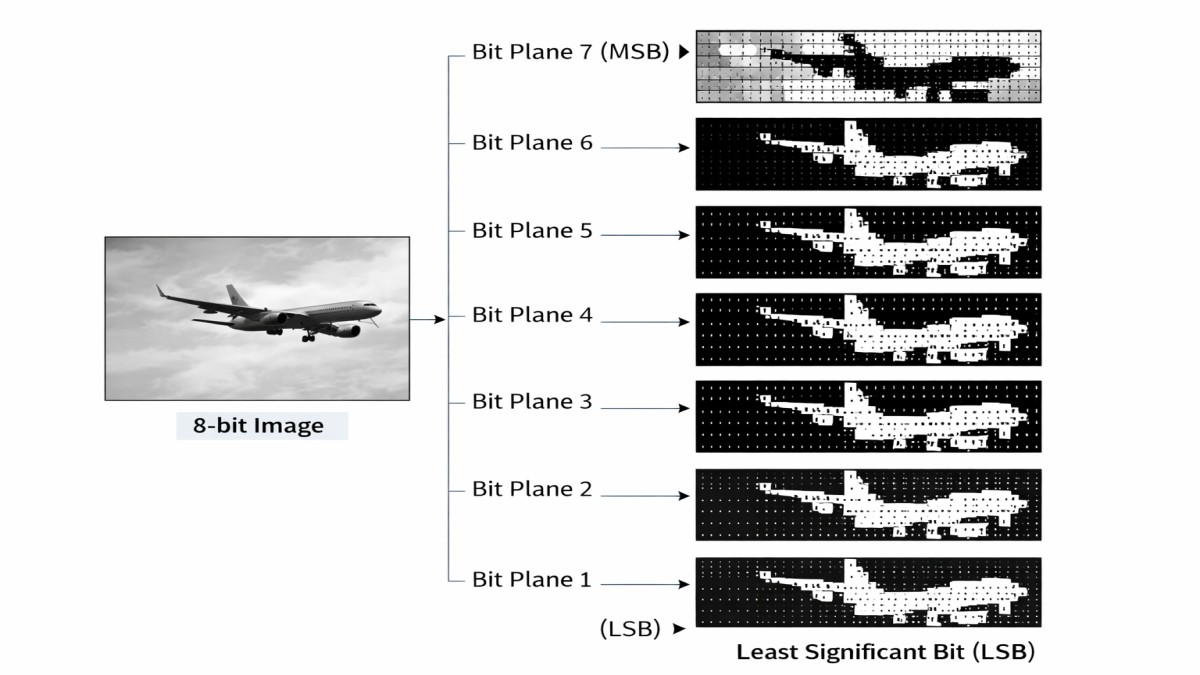
The MSB carries the most visual weight. If you only keep the top few bit planes, you can still recognize the image.
Least Significant Bit (LSB)
LSBs hold subtle details. They are often used in steganography because changes here are hard to notice with the human eye.
Visual Importance of Different Bit Planes
Higher bit planes define shapes and contrast. Lower ones add texture. Remove MSBs and the image collapses. Remove LSBs and the image still looks fine—just less detailed.
Bit Plane in Grayscale Images
In grayscale images, bit plane slicing is straightforward. An 8-bit image has 8 bit planes. Plane 7 (MSB) is the most visually significant, while plane 0 (LSB) is the least.
Bit Plane in Color Images
RGB Color Model and Bit Planes
Color images have three channels: Red, Green, and Blue. Each channel has its own bit planes. That means a 24-bit image has 24 bit planes in total.
Applications of Bit Plane Slicing
Image Compression
By storing only the most important bit planes, file size can be reduced without a huge loss in quality.
Image Enhancement
Enhancing certain bit planes can improve contrast or highlight specific features.
Steganography and Data Hiding
LSBs are perfect for hiding secret messages inside images without visible distortion.
Medical Imaging
Doctors use bit plane analysis to highlight specific structures in X-rays and MRIs.
Advantages of Bit Plane Analysis
- Simple and effective
- Reveals hidden image information
- Useful for compression and security
- Enhances understanding of image structure
Limitations of Bit Plane Technique
- Not always suitable for complex images
- Sensitive to noise in lower planes
- Requires additional processing steps
Bit Plane vs Pixel Intensity Analysis
Pixel intensity looks at values directly. Bit plane analysis goes deeper, examining how each bit contributes. Think of it as zooming in on the building blocks of an image.
Practical Examples of Bit Plane Usage
From facial recognition to satellite imagery, bit plane slicing is used wherever image detail matters.
Conclusion
Bit planes may seem like a low-level concept, but they unlock a powerful way to understand and manipulate images. From compression to hidden data, bit plane slicing proves that sometimes, the smallest bits make the biggest difference.
FAQs
1. What is a bit plane in simple terms?
A bit plane is a layer of bits from the same position in all image pixels.
2. How many bit planes are in an image?
An 8-bit image has 8 bit planes.
3. Why are MSBs more important than LSBs?
MSBs define the main visual structure of an image.
4. Is bit plane slicing used today?
Yes, especially in image compression, security, and medical imaging.
5. Can bit planes help in hiding data?
Absolutely. LSBs are commonly used for steganography.

Dobutamine: Uses, Mechanism, Dosage, and Side Effects

Nopdle Magazine: Redefining Creative Culture Through Curated Innovation

Shop Easter Basket: The Ultimate Guide to Perfect Easter Gifts

Best Apps to Make Money Online USA (2026 Guide)

How to Start Affiliate Marketing with No Money

Freelance Jobs for Beginners USA (Start with No Experience)

Side Hustle Ideas from Home USA (No Experience Needed) – Beginner’s Guide

Online Jobs from Home USA (Daily Pay) – Start Earning Instantly

Beton Celular Autoclavizat: The Future of Lightweight, Eco-Friendly Construction

Goblets: A Timeless Symbol of Elegance and Celebration
Dobutamine: Uses, Mechanism, Dosage, and Side Effects

Ishraq Time in Delhi: What It Is, When It Happens, and Why It Matters
Beton Celular Autoclavizat: The Future of Lightweight, Eco-Friendly Construction

Read OPM Manga Online: Where and How to Enjoy One Punch Man Legally

Technisches Gymnasium: Your Gateway to Engineering and Technology

Why Every Small Business Needs a Digital Marketing Agency
Goblets: A Timeless Symbol of Elegance and Celebration
Nopdle Magazine: Redefining Creative Culture Through Curated Innovation

Gold Shower: Nature’s Cascading Yellow Wonder

The Indian Bow: A Legacy of Precision, Power, and Tradition
Dobutamine: Uses, Mechanism, Dosage, and Side Effects
Nopdle Magazine: Redefining Creative Culture Through Curated Innovation
Shop Easter Basket: The Ultimate Guide to Perfect Easter Gifts
Best Apps to Make Money Online USA (2026 Guide)
How to Start Affiliate Marketing with No Money
Freelance Jobs for Beginners USA (Start with No Experience)
Side Hustle Ideas from Home USA (No Experience Needed) – Beginner’s Guide
Online Jobs from Home USA (Daily Pay) – Start Earning Instantly
Beton Celular Autoclavizat: The Future of Lightweight, Eco-Friendly Construction
Goblets: A Timeless Symbol of Elegance and Celebration

 entertainment7 months ago
PYT Telegram: A Complete Guide to Understanding, Using, and Maximizing It

 entertainment7 months ago
OnionFlix: Everything You Need to Know About This Streaming Website
- others6 months ago
Nook vs Kindle: Which E-Reader Is Right for You?
- gaming7 months ago
Melisandre: The Enigmatic Priestess of Game of Thrones