others
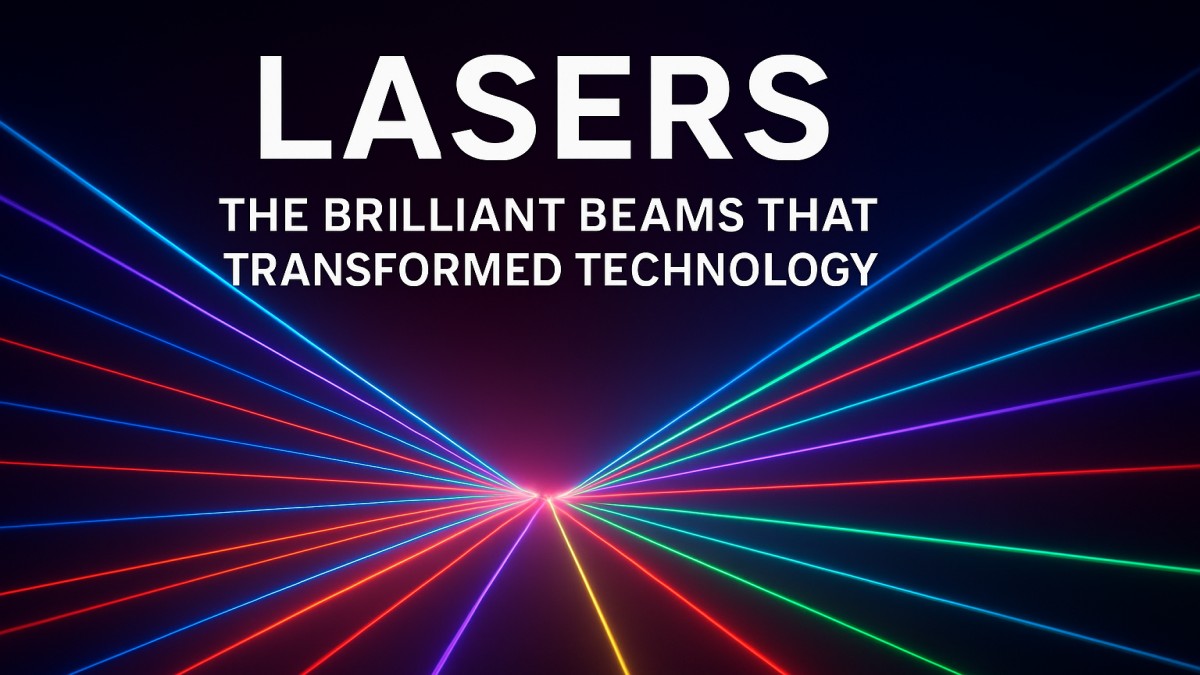
Lasers: The Brilliant Beams That Transformed Technology

Introduction
Lasers. From scanning groceries to performing delicate eye surgeries, lasers have become an essential part of modern life. The word “laser” might bring to mind sci-fi movies or cutting-edge laboratories, but these focused beams of light power many of the technologies we use daily — in medicine, communication, entertainment, and even construction. But what exactly makes a laser so special?
What Is a Laser?
The term LASER stands for Light Amplification by Stimulated Emission of Radiation. In simple terms, it’s a device that produces a narrow, intense beam of light that doesn’t spread out like ordinary light. Unlike a flashlight, which emits light in many directions, a laser produces coherent light — all the photons move in sync and in a single direction.
This focused light can be incredibly powerful, precise, and versatile, depending on how it’s generated and used.
The History of Lasers
The concept of lasers began with Albert Einstein’s theory of stimulated emission in 1917, but it wasn’t until 1960 that the first operational laser was built by Theodore Maiman using a ruby crystal. Initially described as “a solution looking for a problem,” lasers quickly found countless applications.
By the 1970s and 80s, lasers were being used in medicine, telecommunications, and consumer electronics, and today, they’re everywhere from barcode scanners to fiber-optic internet cables.
How Lasers Work
At its core, a laser works by exciting atoms or molecules to higher energy levels and then stimulating them to emit light. The light bounces between mirrors in a controlled environment, amplifying its intensity until it escapes through one end as a concentrated beam.
Here’s a simple breakdown:
- Energy Source: Provides power to excite the atoms.
- Gain Medium: The material (gas, liquid, or solid) that amplifies light.
- Mirrors: One fully reflective and one partially reflective mirror help create and release the beam.
This process results in light that is monochromatic (one color), coherent, and directional — the three defining properties of a laser beam.
Key Components of a Laser System
- Gain Medium: The core material that produces laser light (e.g., crystal, gas, or semiconductor).
- Pump Source: Provides energy to the gain medium.
- Optical Cavity: The chamber that contains mirrors to amplify the light.
- Output Coupler: Allows the laser beam to exit while maintaining the amplification process.
Different Types of Lasers
There are several types of lasers, each suited for specific applications.
1. Solid-State Lasers
Use solid materials like ruby or neodymium-doped crystals. Common in medical and industrial cutting tools.
2. Gas Lasers
Use gases like helium-neon or carbon dioxide. CO₂ lasers are popular in engraving and cutting applications.
3. Semiconductor (Diode) Lasers
Found in everyday devices — DVD players, barcode scanners, and laser pointers.
4. Fiber Lasers
Use optical fibers doped with rare earth elements. Known for high efficiency and precision in manufacturing.
5. Dye Lasers
Use organic dye solutions. They’re tunable, meaning their wavelength can be adjusted, making them useful in scientific research.
Applications of Lasers in Everyday Life
Lasers quietly power many aspects of our lives, such as:
- Barcode Scanners at stores
- Laser Printers for office use
- CD/DVD/Blu-ray Players
- Laser Pointers for presentations
- LIDAR Systems for autonomous vehicles
They even make your fiber-optic internet possible by transmitting data through beams of light at lightning speed.
Medical Uses of Lasers
In healthcare, lasers are a game-changer. They allow doctors to perform precise, minimally invasive procedures. Common medical applications include:
- LASIK Eye Surgery: Corrects vision by reshaping the cornea.
- Laser Dentistry: Reduces pain and speeds healing.
- Cancer Treatment: Targets and destroys tumors.
- Skin Treatments: Used for removing tattoos, scars, and wrinkles.
Lasers combine accuracy with reduced recovery time, making them ideal for modern medicine.
Lasers in Industry and Manufacturing
In industrial settings, lasers have revolutionized production. They’re used for:
- Cutting and Welding Metals
- Engraving and Marking
- 3D Printing (Laser Sintering)
- Quality Inspection using Laser Scanning
Fiber and CO₂ lasers are particularly favored for precision cutting due to their consistency and power.
Conclusion
From entertainment to exploration, lasers have illuminated nearly every corner of human innovation. They’re more than just beams of light — they’re tools of precision, progress, and possibility. Whether scanning barcodes, cutting metal, or curing disease, lasers are shaping our world one photon at a time.
FAQs
1. What does “laser” stand for?
Laser stands for Light Amplification by Stimulated Emission of Radiation.
2. Are lasers dangerous to the eyes?
Yes. Direct exposure to strong laser beams can cause eye injury; always use safety gear.
3. What are the most common uses of lasers?
Lasers are widely used in medicine, manufacturing, telecommunications, and entertainment.
4. Can lasers cut through metal?
Yes. Industrial CO₂ and fiber lasers can cut through metals with extreme precision.
5. What is the future of laser technology?
Expect advancements in fusion energy, quantum communication, and medical nanolasers.

Dobutamine: Uses, Mechanism, Dosage, and Side Effects

Nopdle Magazine: Redefining Creative Culture Through Curated Innovation

Shop Easter Basket: The Ultimate Guide to Perfect Easter Gifts

Best Apps to Make Money Online USA (2026 Guide)

How to Start Affiliate Marketing with No Money

Freelance Jobs for Beginners USA (Start with No Experience)

Side Hustle Ideas from Home USA (No Experience Needed) – Beginner’s Guide

Online Jobs from Home USA (Daily Pay) – Start Earning Instantly

Beton Celular Autoclavizat: The Future of Lightweight, Eco-Friendly Construction

Goblets: A Timeless Symbol of Elegance and Celebration
Dobutamine: Uses, Mechanism, Dosage, and Side Effects

Ishraq Time in Delhi: What It Is, When It Happens, and Why It Matters
Beton Celular Autoclavizat: The Future of Lightweight, Eco-Friendly Construction

Read OPM Manga Online: Where and How to Enjoy One Punch Man Legally

Technisches Gymnasium: Your Gateway to Engineering and Technology

Why Every Small Business Needs a Digital Marketing Agency
Goblets: A Timeless Symbol of Elegance and Celebration

Gold Shower: Nature’s Cascading Yellow Wonder
Nopdle Magazine: Redefining Creative Culture Through Curated Innovation

The Indian Bow: A Legacy of Precision, Power, and Tradition
Dobutamine: Uses, Mechanism, Dosage, and Side Effects
Nopdle Magazine: Redefining Creative Culture Through Curated Innovation
Shop Easter Basket: The Ultimate Guide to Perfect Easter Gifts
Best Apps to Make Money Online USA (2026 Guide)
How to Start Affiliate Marketing with No Money
Freelance Jobs for Beginners USA (Start with No Experience)
Side Hustle Ideas from Home USA (No Experience Needed) – Beginner’s Guide
Online Jobs from Home USA (Daily Pay) – Start Earning Instantly
Beton Celular Autoclavizat: The Future of Lightweight, Eco-Friendly Construction
Goblets: A Timeless Symbol of Elegance and Celebration

 entertainment7 months ago
PYT Telegram: A Complete Guide to Understanding, Using, and Maximizing It

 entertainment7 months ago
OnionFlix: Everything You Need to Know About This Streaming Website
- others6 months ago
Nook vs Kindle: Which E-Reader Is Right for You?
- gaming7 months ago
Melisandre: The Enigmatic Priestess of Game of Thrones