Health
Understanding Water-Soluble Substances: Meaning, Importance, and Applications

Introduction
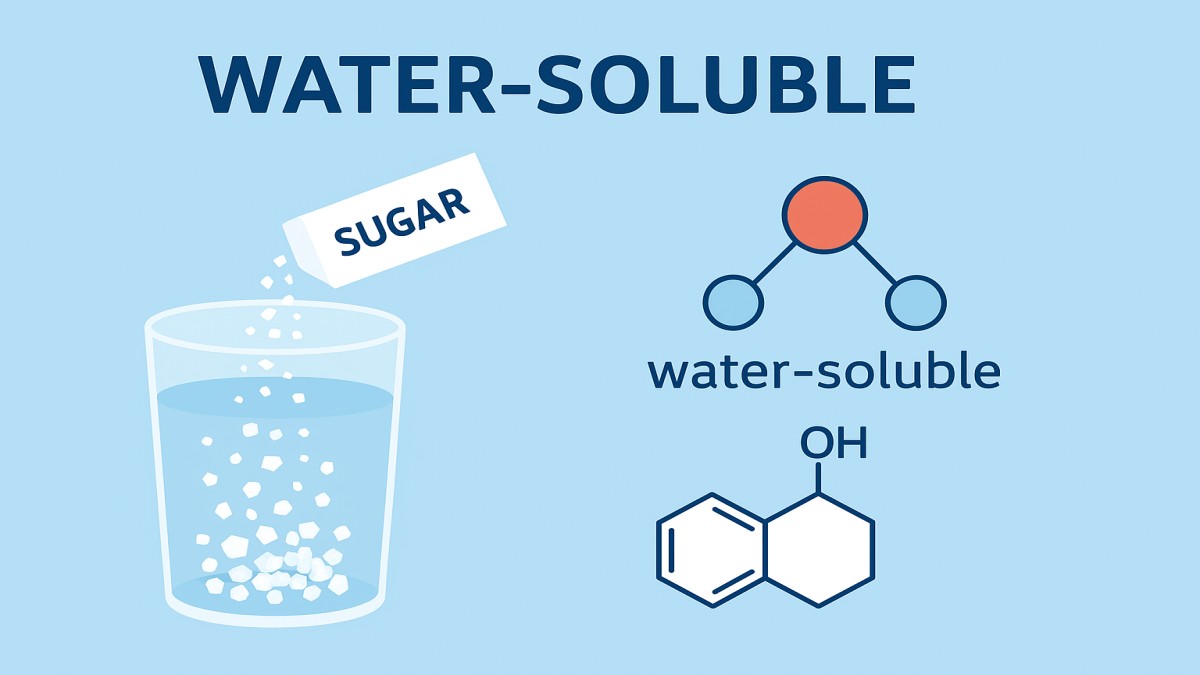
Water-Soluble. Have you ever wondered why sugar melts in your coffee or why salt disappears when you stir it into soup? That’s the magic of water solubility. Being water-soluble means a substance can dissolve in water an essential property that influences chemistry, biology, nutrition, and even the environment. From vitamins to cleaning agents, water solubility plays a vital role in how things function in our world.
What Does “Water Soluble” Mean?
A water-soluble substance is one that dissolves completely in water, forming a homogeneous solution. In simple terms, its particles break apart and spread evenly throughout the water, becoming invisible to the naked eye.
Common examples include:
- Salt (sodium chloride)
- Sugar (sucrose)
- Vitamins B and C
- Certain medications
When these substances mix with water, they form stable solutions that can easily interact with biological systems or be absorbed into the body.
How Solubility Works
Solubility depends on the principle that “like dissolves like.” Water is a polar solvent, meaning its molecules have positive and negative ends. Substances that also have polar molecules or ions can easily interact with water molecules, causing them to dissolve.
For instance:
- Salt dissolves because its ions (Na⁺ and Cl⁻) are attracted to water molecules.
- Sugar dissolves because its hydroxyl groups (–OH) form hydrogen bonds with water.
Non-polar substances like oil, however, do not dissolve in water because there’s no attraction between their molecules and water molecules.
Factors Affecting Water Solubility
Several factors determine how well a substance dissolves in water:
1. Temperature
In most cases, increasing the temperature increases solubility. For example, sugar dissolves faster in hot tea than in cold water.
2. Pressure
For gases, higher pressure increases solubility — which is why soda retains its fizz when sealed.
3. Nature of Solute and Solvent
The chemical structure of the solute and solvent determines whether they can interact effectively.
4. Stirring or Agitation
Stirring helps distribute particles evenly, allowing them to dissolve faster.
Examples of Water-Soluble Substances
1. Water-Soluble Vitamins
- Vitamin C (Ascorbic Acid): Boosts immunity and helps in tissue repair.
- B-Complex Vitamins: Include B1, B2, B3, B6, B12, and folic acid. They play roles in energy metabolism and nerve function.
2. Water-Soluble Minerals
- Potassium, Sodium, and Magnesium dissolve in body fluids and regulate muscle and nerve function.
3. Water-Soluble Drugs
Many medications are designed to be water-soluble for faster absorption in the body. For example, paracetamol dissolves easily in water, allowing for quick relief.
Water Solubility in Daily Life
You encounter water-soluble substances every day, often without realizing it.
1. In Food
Salt, sugar, flavorings, and some colorants dissolve in water during cooking to enhance taste and appearance.
2. In Cleaning Products
Detergents and soaps are made to be water-soluble so they can mix with water to clean dirt and oil effectively.
3. In Medicine
Water-soluble drugs can be taken as syrups, injections, or tablets that dissolve quickly in the stomach.
4. In Agriculture
Water-soluble fertilizers help deliver nutrients directly to plant roots, promoting healthy growth.
Water Solubility in the Human Body
Water solubility is essential for biological functions. Our body is made up of about 60% water, which acts as a solvent for numerous reactions.
- Nutrients and oxygen dissolve in water and travel through the bloodstream.
- Waste products like urea dissolve in water for excretion through urine.
- Enzymes and hormones often rely on water to activate and function properly.
Without water-soluble substances, our cells couldn’t carry out vital processes like digestion, respiration, or detoxification.
Conclusion
Water solubility may seem like a simple concept, but it underpins many essential processes from how we digest food to how industries operate. Whether it’s vitamins that nourish our bodies, medicines that heal us, or products that clean our homes, the ability to dissolve in water makes these substances useful, safe, and efficient. Understanding solubility helps us appreciate the science that shapes our everyday lives.
FAQs
1. What does water-soluble mean in simple terms?
It means a substance can dissolve in water, forming a uniform solution.
2. Why are some vitamins water-soluble?
Because their chemical structure allows them to mix with water, making them easily absorbed and excreted by the body.
3. Is water solubility important in medicine?
Yes, it affects how fast a drug is absorbed and how it travels through the body.
4. Are all cleaning agents water-soluble?
Most are, but some have components that mix with oils to remove greasy dirt.
5. Can water-soluble substances harm the environment?
If misused, yes. Water-soluble chemicals can spread easily in water sources, leading to contamination.

Consultative Selling Techniques: A Complete Guide to Building Customer Trust in 2026

Sales Objection Handling: A Complete Guide to Closing More Deals in 2026

Customer Closing Techniques: A Complete Guide to Converting Prospects into Buyers (2026)

Customer Conversion Process: A Complete Guide to Turning Visitors into Loyal Customers (2026)

Sales Funnel Examples: A Complete Guide to Converting More Customers (2026)

Lead Qualification Framework: A Complete Guide to Finding High-Quality Customers (2026)

Website Credibility Factors: A Complete Guide to Building Trust Online (2026)

Online Reputation Monitoring: A Complete Guide to Protecting Your Brand in 2026

Customer Testimonial Strategy: A Complete Guide to Building Trust and Increasing Sales (2026)

Business Storytelling Framework: A Complete Guide to Building Strong Brand Connections (2026)
Consultative Selling Techniques: A Complete Guide to Building Customer Trust in 2026
Sales Objection Handling: A Complete Guide to Closing More Deals in 2026
Customer Closing Techniques: A Complete Guide to Converting Prospects into Buyers (2026)
Customer Conversion Process: A Complete Guide to Turning Visitors into Loyal Customers (2026)
Sales Funnel Examples: A Complete Guide to Converting More Customers (2026)
Lead Qualification Framework: A Complete Guide to Finding High-Quality Customers (2026)
Website Credibility Factors: A Complete Guide to Building Trust Online (2026)
Online Reputation Monitoring: A Complete Guide to Protecting Your Brand in 2026
Customer Testimonial Strategy: A Complete Guide to Building Trust and Increasing Sales (2026)
Business Storytelling Framework: A Complete Guide to Building Strong Brand Connections (2026)

 entertainment1 year ago
PYT Telegram: A Complete Guide to Understanding, Using, and Maximizing It

 entertainment1 year ago
OnionFlix: Everything You Need to Know About This Streaming Website
- education1 year ago
How to Become a Software Engineer: A Complete Guide
- others12 months ago
Nook vs Kindle: Which E-Reader Is Right for You?